
TL;DR

Get kitchen staples and gadgets delivered free with Prime
- Fast, free delivery on millions of items
- Prime Video, Amazon Music and more included
- Member-only deals all year
A researcher tested whether tartrazine, a yellow food dye used in Doritos, could make raw chicken breast more transparent. The room-temperature experiment produced slight translucency in thin slices, but not the degree described in the research paper being replicated; a stronger solution crystallized. The chicken was discarded, and the result is not evidence that treated chicken is safe to eat.
A home experiment using tartrazine, the yellow-orange food dye found in Doritos, made thin pieces of raw chicken breast slightly translucent, but did not reproduce the stronger transparency reported in a research paper. The experimenter said the chicken soaked for six hours in an approximately 0.19 molar solution showed a grid beneath it in some areas; a more concentrated mixture appeared to crystallize, and the chicken was discarded.
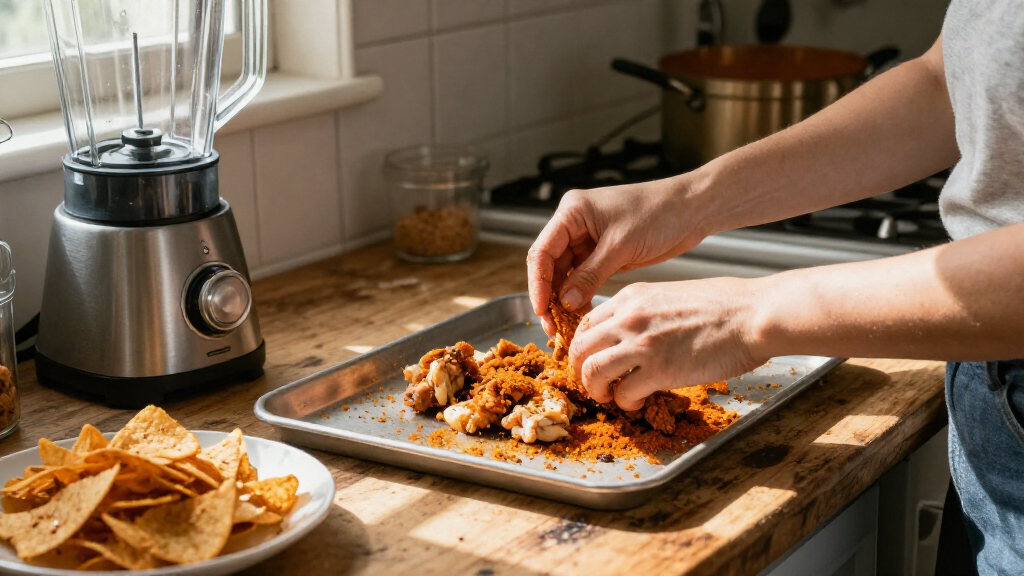
The experiment was presented as a preliminary attempt to replicate parts of a published method for making biological tissue optically transparent. The source describes the paper as using tartrazine on tissues, including chicken breast. In the home test, chicken was soaked at room temperature in dye solutions, with water-soaked pieces serving as controls. The experimenter reported that the water control remained opaque.
For the test that showed limited transparency, a roughly 2-millimeter-thick slice had been cut from a thicker piece and soaked for six hours in an approximately 0.19 M tartrazine solution. With light behind it, grid lines beneath the sample were visible in part of the chicken. The experimenter described its appearance as gelatinous or similar to a gummy sweet, while saying its texture to the touch seemed unchanged.
A higher-concentration solution, listed as approximately 0.56 M, did not produce a usable result: the experimenter said the dye seemed to crystallize and leave the chicken crusty. The source also describes a later, 12-hour room-temperature soak using the lower concentration and a water control. That test showed slight translucency compared with the control, according to the experimenter. The samples were thrown away; no one should interpret the visual result as making raw chicken safe to handle or eat.
Kitchen-scale replication · Tissue optics
A Food Experiment: Making Chicken Transparent Using Dorito Dust
A home test of tartrazine, the yellow-orange dye associated with Doritos, produced slight translucency in a thin raw chicken slice. The result fell short of the research paper’s reported effect.
Some light through. No full transparency.
A grid beneath one thin sample was visible in part. The experimenter called the outcome partial transparency; a stronger mixture appeared to crystallize.
What happened in the test
The experiment adapted a published tissue-transparency approach to a room-temperature home setup. The reported observations were visual and preliminary.
Thin chicken slice
A roughly 2 mm slice soaked for six hours in about 0.19 M tartrazine showed a grid beneath it through part of the sample when lit from behind.
Water stayed opaque
Water-soaked pieces served as controls. The experimenter reported that the water control did not show the same visible translucency.
Crystallized surface
A stronger solution, listed at about 0.56 M, appeared to crystallize and leave the chicken crusty, so it did not produce a usable transparency result.
Home setup
The chicken soaked at room temperature without a machine shaker. A later 12-hour soak using the lower concentration was also described as showing slight translucency compared with its water control.
Raw sampleRoom temperatureVisual observationResearch protocol described
The source says the paper used a 0.62 M tartrazine solution, 40°C conditions, and a machine shaker. Those conditions were not reproduced in the home test, making direct comparison difficult.
0.62 M reported40°C reportedShaker reportedFrom dye bath to observation
The experimenter described this as a warm-up attempt to replicate parts of a published method, rather than a completed replication.
Prepare solutions
Food-grade tartrazine powder was weighed with tap water; a water-only control was included.
Soak raw pieces
Samples sat at room temperature, without the paper’s reported shaker or 40°C conditions.
Check light transmission
Backlighting revealed grid lines beneath part of a thin slice in the lower-concentration test.
Discard samples
The chicken was thrown away. The visual result does not establish food safety.
“I got partial transparency but not to the degree of the paper.”
The experimenter
What the result can—and cannot—show
The suggested mechanism is that tartrazine may alter water’s refractive index, bringing it closer to that of proteins and lipids and reducing light scattering. This kitchen-scale test did not establish that mechanism.
- Grid visibility was a visual observation, with no quantitative transparency measurement.
- The source reports no independent replication or repeated controlled samples.
- Sample thickness, lighting, concentration, and other conditions may affect the appearance.
- Powder was specified as more than 80% dye; approximate volumes mean actual concentrations may differ from nominal values.
- No laboratory analysis established the final solution concentration or the proposed optical mechanism.
Key questions
Did the experiment make chicken fully transparent?
No. The reported result was slight or partial translucency in thin pieces. Grid lines showed through part of one sample, with a weaker effect than the paper described.
What is tartrazine?
Tartrazine is a yellow-orange food dye. The experiment used a food-grade powder described as having more than 80% dye content.
Was the published method reproduced?
Only in part. The home test used room-temperature soaking without a shaker; the source says the paper used a stronger solution, 40°C, and machine shaking.
What comes next?
A more ambitious replication was mentioned, but no timetable, finalized protocol, or later results were provided. Any follow-up would need clear controls and reported conditions.
More from the kitchen guide
Updated shopping guides from thegracefulkitchen.net.
A Low-Cost Test of Tissue Imaging
The experiment matters as a small-scale test of a technique that could affect how researchers view biological tissue. The source says the published approach has been used to make fluorescence imaging in live animals easier. If transparency methods can be adapted safely and at lower cost, they could help independent researchers observe structures inside samples with less specialized equipment.
That possibility remains prospective. This test showed limited translucency in a thin raw sample, not a validated imaging method or a demonstration that the result can be repeated reliably. The experimenter framed it as a warm-up for a more ambitious replication, rather than as a completed replication of the paper.
The result also illustrates a practical limit of taking a laboratory protocol into a home setting. The source says the paper’s protocol used a stronger solution, a temperature of 40°C and a machine shaker. The experimenter did not have the equipment or a way to use those conditions safely, so the home procedure was changed. Those differences make direct comparisons difficult.
As an affiliate, we earn on qualifying purchases.
How the Home Protocol Differed
The source credits the experiment idea to Adaobi Adibe, who sent the experimenter a paper titled “Achieving optical transparency in live animals with absorbing molecules.” The experimenter says the paper used a 0.62 M tartrazine solution, a temperature of 40°C and a machine shaker. The home test instead used room-temperature soaking without a shaker.
The dye was described as a food-grade tartrazine product with more than 80% dye content. The experimenter weighed the powder and tap water to prepare solutions, including a water-only control. Because the powder was not pure dye, and because the stated solution volumes were approximate, the source notes that the actual dye concentrations could be lower than the nominal values.
The proposed explanation is that tartrazine’s light-absorption properties may also change water’s refractive index. The experimenter suggested that bringing the refractive index of water closer to that of proteins and lipids could reduce light scattering and make tissue appear more transparent. That is presented as a working model, not as a mechanism established by this particular kitchen-scale test.
“I got partial transparency but not to the degree of the paper.”
— The experimenter
Limits of the Transparency Result
The source provides no independent replication, quantitative measurement of transparency or controlled comparison across repeated samples. The reported visibility of grid lines is a visual observation, and the effect may depend on sample thickness, lighting, dye concentration and other conditions. The difference between the altered home method and the research protocol also means the results cannot establish how well the original method was reproduced.
The concentration estimates carry uncertainty because the tartrazine powder contained more than 80% dye, according to the product specifications cited by the experimenter. The source does not report a measured final solution volume or a laboratory analysis of the samples. It also does not establish whether the proposed refractive-index mechanism explains the observed appearance.
Food safety is another boundary: the samples were raw chicken left at room temperature, including one planned for a 12-hour soak. The experimenter says the pieces were discarded. No evidence in the source shows that the treatment kills pathogens or makes chicken suitable to eat. The experiment should not be treated as food preparation guidance.
A More Ambitious Replication
The experimenter said a more ambitious replication was planned, but the source gives no timetable, finalized protocol or later results. Any follow-up would need to report its conditions and controls clearly, including concentration, temperature, sample thickness and exposure time, so readers can distinguish a visual observation from a measured effect.
The source does not say whether the next attempt will use the research paper’s 40°C temperature and shaker conditions, or how the experimenter would manage equipment and biological-sample safety. Until further results are reported, the supported conclusion is narrow: under the described room-temperature conditions, a thin raw chicken slice showed some visible translucency, while a stronger solution crystallized.
Key Questions
Did the experiment make the chicken fully transparent?
No. The experimenter reported partial or slight translucency in thin pieces, with grid lines visible beneath part of one sample. The result was weaker than the transparency described in the paper they were attempting to replicate.
What is tartrazine?
Tartrazine is a yellow-orange food dye, also known as E102, that the source identifies as being used in Doritos. The experimenter used a food-grade powder, but the test was an experiment on raw chicken, not a cooking method.
Why might the dye make tissue look more transparent?
The experimenter proposed that tartrazine could alter water’s refractive index, bringing it closer to that of tissue components such as proteins and lipids and reducing light scattering. The source presents this as a working explanation, not a mechanism confirmed by the home test.
Is tartrazine-treated chicken safe to eat?
The source does not establish that the treatment makes chicken safe to eat. The samples were raw and were discarded. Do not eat experimental chicken or assume that dye treatment removes food-safety risks.
Source: Hacker News
Fall Picks
fall essentials
As an affiliate, we earn on qualifying purchases.