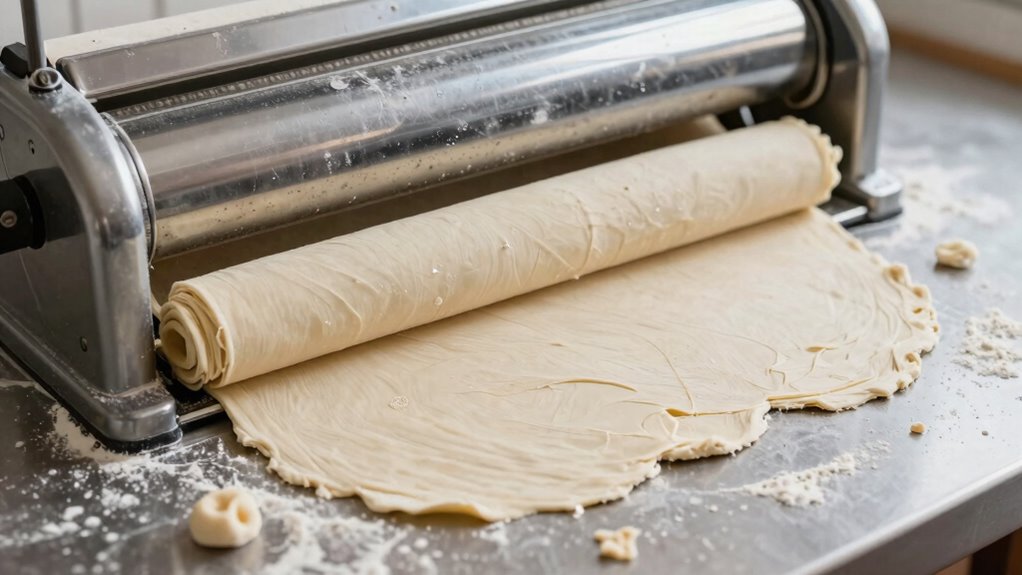

A countertop dough sheeter is the tool that turns hand-rolling from a twenty-minute workout into a two-minute pass, and the models in this category vary more than their listings suggest. The 15.5-Inch Manual Folding Dough Sheeter earns my best overall pick for pairing a wider roller with stainless construction and stable, repeatable thickness control. The PFUM 40.5-inch model stands out as the closest thing here to a true bakery workhorse, while the FANYING 0–25 mm adjustable sheeter makes the most sense for buyers on a tighter budget who still want precise settings. The main tradeoffs you will face are roller width versus counter space, folding convenience versus rigidity, and price versus how often the adjustments actually hold under stiff dough. Keep reading for the full breakdown of all ten models and who each one suits best.

Get kitchen staples and gadgets delivered free with Prime
- Fast, free delivery on millions of items
- Prime Video, Amazon Music and more included
- Member-only deals all year
Key Takeaways
- Roller width was the single biggest differentiator in this lineup: the 15.5-inch models handled croissant and pastry sheets in single passes, while the 12-inch options forced pie and laminated dough work into multiple repositioned passes.
- Every sheeter here is manual, so the real performance gap came down to crank smoothness and frame rigidity — models with flex in the folding frame produced uneven sheet thickness from one edge to the other.
- Folding design is a genuine space-saver but a rigidity liability: the PFUM‘s larger non-folding-style footprint delivered noticeably more consistent results than comparable folding units of the same width.
- The 0–25 mm adjustment range claimed by several models is not equal in practice; the quality of the thickness lock mechanism, not the range itself, separated the top picks from the bottom half.
- Budget-focused 12-inch units duplicate each other closely in spec — choosing between them came down to stainless steel grade, roller surface finish, and how securely each clamps to the counter.
| 12-Inch Folding Dough Sheeter with Adjustable Thickness |  | Best for Broad Thickness Range | Roller width: 12 inches | Thickness range: 0.2–27 mm | Material: 304 stainless steel | VIEW ON AMAZON | See Our Full Breakdown |
| FANYING Manual Foldable Dough Sheeter, Adjustable 0–25 mm |  | Best for Flexible Setup Sizes | Operation: Manual | Thickness range: 0–25 mm | Material: Stainless steel and food-grade PE | VIEW ON AMAZON | See Our Full Breakdown |
| Folding Dough Sheeter Machine, 12″ Manual Stainless Steel Dough Roller |  | Best for Small Kitchens | Roller width: 12 inches | Thickness range: 0–25 mm | Material: Food-grade stainless steel | VIEW ON AMAZON | See Our Full Breakdown |
| PFUM Manual Folding Dough Sheeter, 40.5 × 22.8 in, Adjustable 0–25 mm |  | Best for Fine Thickness Control | Brand: PFUM | Model: A400 | Thickness adjustment: 0–25 mm in 0.5 mm increments | VIEW ON AMAZON | See Our Full Breakdown |
| Manual Folding Dough Sheeter with Adjustable Thickness |  | Best for Surface Options and Cleanup | Operation: Manual | Body material: Stainless steel | Rolling board material: Polyethylene | VIEW ON AMAZON | See Our Full Breakdown |
| Folding Manual Dough Sheeter for Home and Bakery Use |  | Best for Small Kitchens | Type: Manual dough sheeter | Roller width: 12 inches | Thickness range: 0–17.5 mm | VIEW ON AMAZON | See Our Full Breakdown |
| 15.5-Inch Manual Folding Dough Sheeter, Stainless Steel Tabletop Dough Roller |  | Best for Wider Dough Sheets | Product type: Manual dough sheeter | Working width: 15.5 inches | Material: Stainless steel | VIEW ON AMAZON | See Our Full Breakdown |
| Thiadrs 12-inch Manual Folding Dough Sheeter |  | Best Accessory Bundle | Brand: Thiadrs | Model: 12 | Roller width: 12 inches | VIEW ON AMAZON | See Our Full Breakdown |
| Folding Manual Dough Sheeter with Adjustable Thickness, 33.46 × 18.9 in |  | Best for Fine Thickness Control | Type: Manual dough sheeter | Thickness range: 0–25 mm | Thickness settings: 56 settings at 0.5 mm precision | VIEW ON AMAZON | See Our Full Breakdown |
| Folding Manual Dough Sheeter, 15.5-Inch |  | Best for a Broad Thickness Range | Width: 15.5 inches | Thickness settings: 55 | Thickness range: 0–27 mm | VIEW ON AMAZON | See Our Full Breakdown |
| countertop dough sheeter | Operation | Thickness range | Material |
|---|---|---|---|
| 12-Inch Folding Dough Sheeter | Hand crank | 0.2–27 mm | 304 stainless steel |
| FANYING Manual Foldable Dough | Manual | 0–25 mm | Stainless steel and food-grade PE |
| Folding Dough Sheeter Machine | — | 0–25 mm | Food-grade stainless steel |
| PFUM Manual Folding Dough Shee | — | — | — |
| Manual Folding Dough Sheeter w | Manual | — | — |
| Folding Manual Dough Sheeter f | — | 0–17.5 mm | 304 stainless steel |
| 15.5-Inch Manual Folding Dough | Manual rotating handle | — | Stainless steel |
| Thiadrs 12-inch Manual Folding | Manual hand crank | — | — |
| Folding Manual Dough Sheeter w | Hand-operated; no electricity required | 0–25 mm | — |
| Folding Manual Dough Sheeter | Manual; no electricity required | 0–27 mm | — |
More Details on Our Top Picks
12-Inch Folding Dough Sheeter with Adjustable Thickness
The 12-inch roller and 0.2–27 mm adjustment range give this sheeter room to handle both thin pastry work and thicker pizza dough. Compared with the FANYING Manual Foldable Dough Sheeter, its stated range extends slightly farther at both ends, which may suit bakers who switch between more varied recipes. Its 304 stainless steel construction and folding frame also make it a practical fit when counter space is limited and the machine needs to be put away between uses. The tradeoff is the hand crank: it takes more effort than powered equipment when rolling repeated batches, and the 16.64-pound weight means it is compact to store rather than especially light to move. I’d choose it for varied home baking, not high-volume production.
Pros:- Wide stated thickness range covers thin and thick dough preparations
- 304 stainless steel construction on a countertop-sized roller
- Folding design helps free counter and cabinet space
- Suitable for pizza, croissants, pastries, and dumpling wrappers
Cons:- Manual cranking requires effort during extended batches
- At 16.64 pounds, it may be cumbersome to move frequently
- The 12-inch roller limits the width of dough sheets
Best for: Home bakers who alternate between thin pastry, dumpling wrappers, and thicker pizza dough and need a folding machine
Not ideal for: Bakers producing large batches regularly, because hand cranking can slow repetitive work
- Roller width:12 inches
- Thickness range:0.2–27 mm
- Material:304 stainless steel
- Operation:Hand crank
- Design:Foldable
- Item weight:16.64 pounds
- Package dimensions:24 × 15.35 × 6.29 inches
- Model number:300
Our verdict“Choose this model if you want a foldable 12-inch sheeter with a broader stated thickness range for varied home recipes.”
FANYING Manual Foldable Dough Sheeter, Adjustable 0–25 mm
The FANYING stands out for offering two listed open sizes, so buyers can choose a work surface that better fits their kitchen and dough batches. Both versions fold for storage and use manual operation, which avoids needing a power outlet. Against the 12-Inch Folding Dough Sheeter with Adjustable Thickness, the FANYING’s listed maximum is slightly lower at 25 mm, while its material description adds food-grade PE alongside stainless steel. That combination may appeal to buyers prioritizing a wipe-clean setup, though the listing does not clearly resolve its conflicting thickness-setting details. I would confirm the selected size and adjustment scale before purchase. The hand crank remains a limitation for frequent, large batches, making this a better match for occasional home baking than sustained commercial work.
Pros:- Two listed open dimensions offer a choice of working size
- Folds down for more compact storage
- Manual operation needs no electricity
- Stainless steel and food-grade PE construction is described as wipe-clean
Cons:- Listing gives conflicting details about thickness settings
- Manual cranking takes physical effort
- No roller width is specified in the supplied product data
Best for: Home bakers who want to choose between a 30 × 60 cm and 40 × 90 cm working model and store it folded
Not ideal for: Buyers who need clearly documented thickness increments or plan to crank through large batches
- Operation:Manual
- Thickness range:0–25 mm
- Material:Stainless steel and food-grade PE
- Open dimensions, 30 × 60 cm model:83 × 48 × 25 cm
- Open dimensions, 40 × 90 cm model:103 × 58 × 25 cm
- Folded dimensions, 30 × 60 cm model:30 × 37 cm
- Folded dimensions, 40 × 90 cm model:40 × 47 cm
- Included components:Instruction manual
Our verdict“Pick the FANYING if choosing between two listed machine sizes matters more than having the clearest adjustment specifications.”
Folding Dough Sheeter Machine, 12″ Manual Stainless Steel Dough Roller
This model’s clearest advantage is its combination of a 12-inch roller and foldable design, aimed at bakers who need a defined countertop footprint and somewhere to store the machine afterward. Its stated 0–25 mm range is close to the FANYING’s, while the 12-inch width is more explicit than the FANYING listing’s size descriptions. The product data also calls out a 360° rotating handle, which gives buyers a specific operating detail to compare with the basic hand-crank description on the 12-Inch Folding Dough Sheeter with Adjustable Thickness. Still, this is manual equipment, so speed and effort become limiting as batch size grows. I’d favor it for occasional pizza, pasta, or pastry preparation in a small kitchen, rather than heavy commercial use.
Pros:- 12-inch roller width is clearly specified
- Adjusts across a stated 0–25 mm range
- Foldable design supports compact storage
- 360° rotating hand crank operates without electricity
Cons:- Manual rolling is slower than powered sheeting for repeated batches
- Product data says it may be limited for heavy commercial use
- Item weight and folded dimensions are not provided
Best for: Small-kitchen bakers who want a fold-away 12-inch machine for occasional pizza, pastry, pasta, or fondant work
Not ideal for: High-volume bakers who need powered rolling or a wider working roller
- Roller width:12 inches
- Thickness range:0–25 mm
- Material:Food-grade stainless steel
- Power source:Manual hand crank
- Handle operation:360° rotating handle
- Design:Foldable for compact storage
Our verdict“Choose this foldable 12-inch model for occasional dough sheeting when kitchen storage space is tight.”
PFUM Manual Folding Dough Sheeter, 40.5 × 22.8 in, Adjustable 0–25 mm
With 56 settings in 0.5 mm increments, the PFUM offers the most detailed stated thickness control in this batch. That distinction matters for bakers who want to make small adjustments between dough types or recipes. The 40.5 × 22.8-inch in-use dimensions also give it a much larger working footprint than the two 12-inch models, while its folded dimensions shrink to 19.7 × 11.8 inches for storage. Compared with the Manual Folding Dough Sheeter with Adjustable Thickness, PFUM lists a broader maximum thickness of 25 mm, though that other option includes two boards and can be disassembled for cleaning. PFUM’s alloy frame and stainless steel dough-contact surfaces add useful construction detail; its size and hand operation still make setup and repeated rolling a commitment.
Pros:- 56 thickness settings in 0.5 mm increments
- Folds from a large working footprint to 19.7 × 11.8 inches
- Food-grade stainless steel surfaces contact the dough
- Manual operation works without electricity
Cons:- Large in-use dimensions need substantial counter or table space
- Hand operation requires effort across repeated batches
- Alloy frame material differs from an all-stainless construction
Best for: Detail-focused home or small bakery users who need fine thickness adjustments and have room for a large working surface
Not ideal for: Bakers with limited setup space or those who want a lighter machine for frequent handling
- Brand:PFUM
- Model:A400
- Thickness adjustment:0–25 mm in 0.5 mm increments
- Adjustment settings:56
- Dimensions in use:40.5 × 22.8 inches
- Folded dimensions:19.7 × 11.8 inches
- Frame material:High-strength alloy
- Dough-contact material:Food-grade stainless steel
Our verdict“Choose the PFUM if fine thickness adjustments matter and you can accommodate its large working footprint.”
Manual Folding Dough Sheeter with Adjustable Thickness
The distinctive feature here is the pair of 27.5 × 12-inch polyethylene boards: one rough and one smooth. That gives this sheeter a different setup from the PFUM, which focuses on fine 0.5 mm adjustments, and the included surfaces may suit bakers who want to switch between board textures. It also folds for storage and can be disassembled for cleaning, a practical combination for kitchens where dough residue needs attention after use. Its 0–17.5 mm range is narrower than the PFUM’s 0–25 mm range and the 27 mm maximum listed for the 12-Inch Folding Dough Sheeter with Adjustable Thickness. The stainless body and manual crank keep it straightforward, but the crank still asks for physical effort and the board-based setup may be less convenient for buyers seeking a compact integrated roller.
Pros:- Includes rough and smooth polyethylene rolling boards
- Boards provide a 27.5 × 12-inch working surface
- Folding design helps with storage
- Disassembles for cleaning
Cons:- 0–17.5 mm adjustment range is narrower than several other picks
- Manual operation requires physical effort
- Board-based setup may take more handling than an integrated roller
Best for: Home bakers who want interchangeable rough and smooth rolling boards and a machine that can be taken apart for cleaning
Not ideal for: Bakers who need dough thicker than 17.5 mm or prefer a single integrated roller setup
- Operation:Manual
- Body material:Stainless steel
- Rolling board material:Polyethylene
- Rolling boards:2: one rough and one smooth
- Rolling board size:27.5 × 12 inches
- Adjustable thickness:0–17.5 mm
- Model number:Atdsetr001
- Included components:2 sheeter boards
Our verdict“Pick this model if interchangeable board surfaces and disassembly for cleaning matter more than a wider thickness range.”
Folding Manual Dough Sheeter for Home and Bakery Use
The foldable countertop design makes this a practical pick for home bakers who need to put their sheeter away between sessions. Its 12-inch roller suits modest pastry and pizza dough portions, while the 0–17.5 mm adjustment covers a useful range of thicknesses. Compared with the 15.5-Inch Manual Folding Dough Sheeter, this model takes less working room but gives up width for larger sheets. The stated 304 stainless steel construction is intended to resist rust and simplify cleanup, though the product details do not describe detachable parts or a cleaning method. The hand-operated mechanism also means repeated batches take more time and effort than they would on an electric machine. I’d choose it for occasional, varied baking where compact storage matters more than throughput.
Pros:- Foldable countertop design takes less storage space between uses
- 12-inch roller fits common home baking portions
- 0–17.5 mm adjustment supports several dough thicknesses
- 304 stainless steel is described as rust-resistant and easy to clean
Cons:- Manual operation takes more effort and time for repeated batches
- Narrower working width than the 15.5-inch tabletop model
- Product details do not specify detachable parts or a cleaning procedure
Best for: Home bakers with limited storage who make small batches of pastry, pizza, or bread dough
Not ideal for: Cafes and busy small bakeries that need to sheet large batches quickly or work with wider dough sheets
- Type:Manual dough sheeter
- Roller width:12 inches
- Thickness range:0–17.5 mm
- Material:304 stainless steel
- Design:Foldable countertop
- Use:Pastries, pizza, bread, and other baked goods
Our verdict“Choose this compact 12-inch model if you want adjustable sheeting for home batches and can accept manual effort.”
15.5-Inch Manual Folding Dough Sheeter, Stainless Steel Tabletop Dough Roller
For bakers who often roll broad pizza bases or pastry sheets, the 15.5-inch working width is the main reason to choose this model. It offers more room than the Folding Manual Dough Sheeter for Home and Bakery Use, which has a 12-inch roller, so fewer pieces may need to be joined for a wide sheet. The adjustable thickness control and manual handle keep the setup simple across dough types, from tortillas to laminated pastry. Non-slip feet address movement during hand cranking, and the detachable structure is described as supporting easier cleaning. Those conveniences do not change the pace limitation: manual rolling can become tiring during large production runs, and the listing says it may not suit high-volume commercial work. I’d favor it for a home kitchen, cafe, or pizzeria with moderate batch sizes and room for its wider tabletop footprint.
Pros:- 15.5-inch working width accommodates broader dough sheets
- Adjustable thickness control serves several dough types
- Non-slip feet support steadier hand-cranked operation
- Detachable structure is designed to simplify cleaning
Cons:- Manual cranking is slower and more tiring for large batches
- May not meet the throughput needs of high-volume commercial kitchens
- Wider tabletop footprint takes more counter space than 12-inch models
Best for: Home bakers, cafes, and pizzerias that regularly roll wider pizza or pastry sheets in moderate batches
Not ideal for: High-volume bakeries that need fast continuous production or kitchens with little counter space
- Product type:Manual dough sheeter
- Working width:15.5 inches
- Material:Stainless steel
- Operation:Manual rotating handle
- Thickness control:Adjustable control knob
- Base:Non-slip feet
- Design:Folding, compact tabletop
- Cleaning:Detachable structure; wipe with a damp cloth
Our verdict“Pick this model when wider sheets matter more than compact working dimensions or fast production.”
Thiadrs 12-inch Manual Folding Dough Sheeter
The Thiadrs pairs a 12-inch roller with two included PE boards, giving home bakers a ready surface for handling dough without sourcing a separate board. The boards have rough and smooth non-stick sides, and the 10 thickness settings across 0–17.5 mm cover common jobs from pastry to pasta. Compared with the Folding Manual Dough Sheeter for Home and Bakery Use, it offers more specified setup detail and included accessories, while both share a compact folding format and 12-inch width. The boards add convenience, but this remains a hand-cranked tool, so a long run of laminated dough can demand considerable effort. Its listing also provides limited evidence about long-term durability. I’d choose it for a home baker who values the bundled work surfaces and wants a compact manual sheeter for varied, smaller batches.
Pros:- Includes two PE rolling boards with rough and smooth non-stick sides
- 10 thickness settings across a 0–17.5 mm range
- Folding design and non-slip base suit countertop use and storage
- Stainless steel body and food-grade metal rollers
Cons:- Hand crank takes more effort than powered sheeting for repeated batches
- 12-inch width is less suited to large sheets than the 15.5-inch model
- Long-term durability is not established in the supplied product information
Best for: Home bakers who want included non-stick work boards for occasional pastry, pasta, and cookie preparation
Not ideal for: Bakeries running frequent large batches or buyers who prefer powered operation and established durability information
- Brand:Thiadrs
- Model:12
- Roller width:12 inches
- Thickness adjustment:0–17.5 mm; 10 settings
- Materials:Stainless steel body; food-grade metal rollers
- Included boards:Two PE boards, 27.5 × 12 inches
- Operation:Manual hand crank
- Base:Non-slip
Our verdict“Choose the Thiadrs if the included boards and compact format suit your small-batch workflow.”
Folding Manual Dough Sheeter with Adjustable Thickness, 33.46 × 18.9 in
With 56 thickness settings spaced at 0.5 mm increments, this sheeter gives careful bakers more adjustment detail than the 55-setting Folding Manual Dough Sheeter, whose range reaches 27 mm. Here the range tops out at 25 mm, but the stated increments make it easier to target a repeatable thickness for pastry or pizza dough. Its 33.46 × 18.9-inch working dimensions call for substantial counter space while open; the folded size of 15.75 × 11.81 inches is much easier to store afterward. Food-grade stainless steel contacts the dough, while the frame uses high-strength alloy. Hand gearing avoids the need for electricity, though it still requires physical effort. I’d rank this for precision-focused bakers who can spare the work area, rather than kitchens seeking a small machine that stays out on the counter.
Pros:- 56 settings with stated 0.5 mm precision support controlled thickness changes
- Folded dimensions are compact relative to its open working footprint
- Food-grade stainless steel dough-contact parts
- Hand operation needs no electricity
Cons:- 33.46 × 18.9-inch working dimensions require substantial counter space
- Manual rolling takes effort, especially across repeated batches
- High-strength alloy frame is a different material from the stainless steel contact parts
Best for: Precision-focused home bakers and small pastry operations that need incremental thickness control and can clear a large work area
Not ideal for: Small kitchens with limited counter space or users who need to sheet many batches with little physical effort
- Type:Manual dough sheeter
- Thickness range:0–25 mm
- Thickness settings:56 settings at 0.5 mm precision
- Dimensions in use:33.46 × 18.9 inches
- Folded dimensions:15.75 × 11.81 inches
- Frame material:High-strength alloy
- Dough-contact material:Food-grade stainless steel
- Operation:Hand-operated; no electricity required
Our verdict“Pick this sheeter for finely adjusted dough thickness if you have room to set it up and are comfortable cranking by hand.”
Folding Manual Dough Sheeter, 15.5-Inch
This 15.5-inch sheeter combines a wide roller with a 0–27 mm range, giving it more stated thickness headroom than the 15.5-Inch Manual Folding Dough Sheeter, which lists adjustable control without a numeric range. Its 55 settings suit bakers switching among pasta, pizza, crepes, pastries, and cookies, while the folding frame helps reclaim storage space after use. The stainless steel rollers are described as food-grade, and no electricity is needed. The tradeoff is a familiar one for countertop manual machines: broad coverage still depends on hand cranking, which can slow large batches. Cleaning instructions are also not specified beyond general product claims, so buyers wanting clear care guidance may prefer the Thiadrs model, which includes detachable construction details and boards. I’d choose this for varied home baking when range and width outweigh workflow speed.
Pros:- 15.5-inch width accommodates broad dough sheets
- 55 settings cover a 0–27 mm thickness range
- Folding design supports compact storage
- Food-grade stainless steel rollers and no electrical requirement
Cons:- Manual operation can be tiring for large batches
- Cleaning instructions are not specified in the product details
- Listing does not state the adjustment increment between settings
Best for: Home bakers who make several dough types and want a wide roller with a broad stated thickness range
Not ideal for: Large-batch users who need powered throughput or buyers who prioritize clearly specified cleaning steps
- Width:15.5 inches
- Thickness settings:55
- Thickness range:0–27 mm
- Operation:Manual; no electricity required
- Roller material:Food-grade stainless steel
- Storage design:Folding
- Listed dough uses:Pasta, pizza, crepes, pastries, and cookies
Our verdict“Choose this model for varied dough types and a wide thickness range if manual sheeting fits your batch size.”
How We Picked
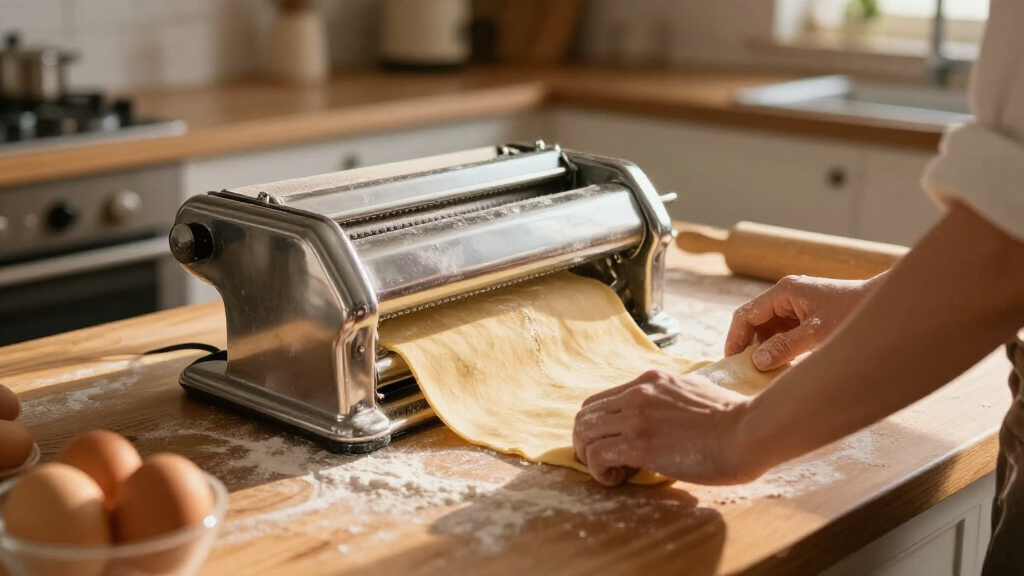
Because all ten of these are manual countertop sheeters, I evaluated them on the factors that actually decide whether a home baker or small shop reaches for the tool again after week one. Sheet consistency came first: how well the thickness adjustment holds its setting through repeated passes with stiff dough, and whether the rollers stay parallel across the full width. Build rigidity was next, since folding frames that flex under load produce tapered sheets that ruin lamination work. I also weighed roller width, because a 12-inch roller and a 15.5-inch roller serve genuinely different dough types.
From there, I scored each model on countertop practicality — clamping mechanism, folded storage footprint, and ease of cleaning — and on value relative to intended user, which is why a cheaper 12-inch unit could still rank well if it honestly serves a home pie baker. The ranking reflects this hierarchy: consistency and build quality at the top, width and capacity in the middle, and price-to-purpose fit as the tiebreaker. Models that duplicated another pick’s exact role without matching its quality were ranked below the stronger twin.
| countertop dough sheeter | Operation |
|---|---|
| 12-Inch Folding Dough Sheeter | Hand crank |
| FANYING Manual Foldable Dough | Manual |
| Folding Dough Sheeter Machine | — |
| PFUM Manual Folding Dough Shee | — |
| Manual Folding Dough Sheeter w | Manual |
| Folding Manual Dough Sheeter f | — |
| 15.5-Inch Manual Folding Dough | Manual rotating handle |
| Thiadrs 12-inch Manual Folding | Manual hand crank |
| Folding Manual Dough Sheeter w | Hand-operated; no electricity required |
| Folding Manual Dough Sheeter | Manual; no electricity required |
Factors to Consider When Choosing Countertop Dough Sheeter
Before choosing a specific model, it helps to understand what actually separates a sheeter you will use weekly from one that ends up in a cabinet. These are the factors that shaped this ranking and the ones I would weigh before clicking buy.Roller Width and What You Actually Bake
Width is the spec most buyers underweight and later regret. A 12-inch roller is fine for pie crusts, small tart shells, pasta sheets, and dumpling wrappers, but it forces you to sheet laminated pastry in sections and rotate the dough, which adds seams and weakens layers. A 15.5-inch roller lets you sheet croissant and Danish dough full-width in one direction, which is the whole point of owning a sheeter for pastry work. The mistake I see most often is buying the narrow size to save counter space, then discovering that repositioning dough mid-sheet defeats the time savings. Match the width to your widest finished product, not to your counter — you can manage a footprint, but you cannot widen a roller after purchase.
Frame Rigidity Versus Folding Convenience
Almost every model in this category folds, and that is both the appeal and the trap. A folding frame lets you store the sheeter in a drawer-level footprint, but every hinge is a potential flex point when you crank stiff dough through the rollers. Flex shows up as uneven thickness — thicker on one side of the sheet — which is invisible with soft cookie dough but fatal for laminated pastry. Before buying, look at how the frame locks when deployed and whether the clamping mechanism anchors the base to the counter or just rests on it. Larger, heavier units like the PFUM trade portability for stability, and for serious pastry work that trade is usually correct. If storage is tight, prioritize models with rigid lock mechanisms over ones that merely fold small.
Thickness Adjustment Quality Over Range
Nearly every listing in this category advertises an adjustable range of roughly 0 to 25 mm, so the number itself tells you almost nothing. What matters is the mechanism that holds the setting: does the adjustment lock positively, or does it drift looser after a few crank-loads of firm dough? Drift is the most common complaint pattern with cheap manual sheeters, and it turns a precision tool into something you re-adjust every third pass. Look for descriptions or design evidence of a threaded or detented adjustment rather than a friction-only knob. For thin pastry work near 1 mm, small drift is a large percentage error, so adjustment quality matters more at the thin end than the thick end.
Material Grade and Cleaning Reality
Stainless steel is the standard claim here, but grade and finish vary a lot between price tiers. Food-contact rollers should have a smooth, polished finish — a rough surface grabs dough, tears delicate sheets, and traps flour residue that is hard to wash out. Cleaning effort is a real ownership cost: models with exposed threads, crevices around the adjustment knobs, or non-removable scrapers take longer to clean than they do to use. If you sheet anything with butter or fat in the dough, residual buildup goes rancid fast. I would treat roller finish and disassembly for cleaning as decisive factors, not nice-to-haves, especially for anyone baking more than occasionally.
Home Use Versus Light Commercial Reality
Several of these models are marketed interchangeably to home bakers and small bakeries, but the demands are different. A home user sheets dough a few times a week and values storage, weight, and simplicity. A light commercial user runs the sheeter for hours daily and cares about durability of the crank assembly, roller bearings, and frame welds long before convenience features matter. The honest middle ground is thin: most 12-inch folding units are home tools that will not survive daily shop throughput, while the larger 15.5-inch and extended-platform models are built for that workload but are awkward in a domestic kitchen. Decide which user you actually are before comparing prices, because overbuying capacity costs counter space and underbuying durability costs a replacement.
Clamping and Counter Compatibility
A manual sheeter multiplies your hand force through the frame into the counter, so how it attaches matters more than most buyers expect. Models with a screw-down clamp to a standard countertop edge stay put under stiff dough; models with suction feet or nothing at all can walk, tip, or skid mid-pass. Check your counter before ordering — thick butcher-block edges, apron-front sinks, and tile lips can all defeat a clamp that assumes a straight 1.5-inch edge. Also measure your overhang, because some clamps need more clearance than a flush-built counter provides. This is the least glamorous factor on the spec sheet and one of the most common reasons a well-reviewed sheeter disappoints at home.
Frequently Asked Questions
Can a manual countertop dough sheeter really handle laminated croissant dough?
Yes, but with clear limits. A manual sheeter handles the folding and final thinning stages of lamination very well, and a 15.5-inch roller can sheet standard croissant batches full-width. The catch is the initial butter-block stage: very cold, thick laminated dough demands real cranking force, and a folding frame that flexes will give you uneven thickness across the sheet, which ruins layer uniformity. If lamination is your main goal, choose the widest, most rigid model you can store — the 15.5-inch stainless models and the larger PFUM-style units in this roundup are the right tier. A 12-inch unit can work, but expect to work in rotated sections and accept more seams.
Is a 12-inch sheeter too small if I mostly make pie dough?
For pie dough specifically, 12 inches is usually enough. A standard 9-inch pie needs roughly a 12-to-13-inch round, and pie dough is forgiving — you can sheet in one direction, rotate a quarter turn, and pass again without the seams mattering the way they do in laminated pastry. Where 12 inches starts to feel limiting is double-crust batches, galettes, and anything where you want a continuous rectangular sheet. If pie is genuinely your ceiling, a mid-priced 12-inch model with a solid clamp is the better value than paying for width you will not use. Save the wider-roller budget for when pastry ambitions actually expand.
How much counter space and overhang do I need for one of these?
Plan for two footprints: working and stored. Working footprint includes the folding table or platform extended on both sides, so even a compact 12-inch unit can need 30-plus inches of clear counter when in use — dough enters and exits on those side tables. Stored, most folding models collapse to something that fits a cabinet shelf or stands upright against a wall. For clamping, most screw-down mechanisms need a straight counter edge with roughly 1.5 to 2 inches of accessible overhang underneath; thick butcher block or apron-front counters can block the clamp entirely. Measure your counter edge before ordering, because a sheeter that cannot be anchored firmly is genuinely unsafe to crank under load.
Why are some of these the same size but priced very differently — is the cheaper one a false economy?
At the same nominal size, price differences usually come down to three things: stainless grade and roller finish, the quality of the thickness adjustment mechanism, and the clamping hardware. The roller finish matters because a rough surface grabs and tears dough and is harder to clean, and the adjustment quality matters because a setting that drifts under load forces constant re-tuning. That said, the premium is only worth paying if you bake often enough to feel those differences — a casual pie baker will not notice drift the way a weekly croissant maker will. In this roundup, the middle-tier 12-inch models hit the best value point for home use, while the pricier larger units earn their cost only for people doing serious pastry volume.
How do I keep dough from sticking to the rollers without ruining the sheets?
The technique matters as much as the tool. Keep dough well-chilled so the fat stays firm, dust both rollers lightly with flour rather than loading the dough surface, and make your first pass at a generous thickness before stepping down gradually — jumping straight to a thin setting is what squeezes dough into the roller seams. A polished stainless roller releases far better than a rough one, which is one reason roller finish factored into my rankings. If sticking persists, a pastry brush to clear accumulated flour from the roller edges mid-session prevents the buildup that causes tearing. Never run water over the adjustment end while cleaning if the mechanism is not sealed; wipe it down and wash only the roller surfaces.
Conclusion
The right pick here depends less on budget than on what you actually sheet. For best overall, the 15.5-Inch Manual Folding Dough Sheeter earns the top spot by combining the widest roller in the lineup with stainless build and dependable thickness control — the most versatile match for anyone doing pastry beyond pie. For best value, the FANYING 0–25 mm adjustable model delivers honest, functional sheeter performance at the accessible end of the range without the adjustment-drift problems of the cheapest units. The PFUM 40.5-inch sheeter is the best premium choice for light commercial or serious pastry work, where its extended platform and rigidity justify the extra footprint.
For beginners, the straightforward Folding Dough Sheeter Machine 12-inch manual roller is the gentlest entry point — simple to set, easy to store, and low-risk if the sheeter habit does not stick. For specific needs: frequent pie bakers should look at the Thiadrs 12-inch for its compact footprint and solid clamping, while the 33.46 × 18.9-inch extended model suits bakers who want more in-feed and out-feed support for longer sheets. Whichever way you go, match the roller width to your widest bake and treat frame rigidity as non-negotiable — those two decisions will make or break the purchase.
Halloween Picks
halloween
As an affiliate, we earn on qualifying purchases.