A fermentation temperature controller helps keep a brew within its target range by switching compatible heating or cooling equipment on and off. My best overall pick is the Inkbird Wi-Fi ITC-308, which pairs dual-stage control with remote monitoring; the standard Inkbird ITC-308 models offer a simpler outlet-based alternative, while the DEWENWILS Smart Temperature Controller suits brewers who want smart features. The main tradeoffs are outlet control versus a wired installation, basic operation versus connectivity, and whether a model matches your heating and cooling setup. Read on for how the 12 options differ and which one fits your fermentation space.

Get kitchen staples and gadgets delivered free with Prime
- Fast, free delivery on millions of items
- Prime Video, Amazon Music and more included
- Member-only deals all year
Key Takeaways
- Dual-stage outlet control is the clearest fit for a fermentation chamber that may need both heat and cooling; several Inkbird ITC-308 variants offer that approach, while the ITC-1000 and 12V Inkbird require more attention to wiring and system compatibility.
- Wi-Fi changes how you monitor a ferment, not the underlying need for a compatible probe and equipment: the Inkbird Wi-Fi ITC-308 stands out for remote access, while standard ITC-308 versions keep operation local.
- Smart features are not the same as brewing-specific fit. The DEWENWILS adds smart control and memory, but buyers should check its sensor behavior and outlet configuration against their fermentation setup.
- Reptile and heat-mat thermostats are narrower tools. BN-LINK and VIVOSUN models are aimed at temperature-limited heating, making them less flexible than dual-stage controllers for managing a chamber that also needs active cooling.
- Similar model names make specification checks essential. The listed ITC-308 variants differ in descriptions and stated capacity, so confirm voltage, load limits, included probe, and outlet layout before choosing among them.
| Inkbird ITC-1000 Dual Stage Digital Temperature Controller |  | Best Value for DIY Builders | Brand: Inkbird | Model: ITC-1000 | Voltage: 110 Volt | VIEW ON AMAZON | See Our Full Breakdown |
| bayite BTC211 Temperature Controller, 1650W, 15A |  | Best Higher-Wattage Plug-and-Play | Controller type: Plug and play | Temperature control: Heating and cooling | Maximum output load: 1650W at 110V | VIEW ON AMAZON | See Our Full Breakdown |
| DEWENWILS Smart Temperature Controller, 15A Smart Thermostat with Memory |  | Best Smart Features | Brand: DEWENWILS | Amperage: 15A | Temperature range: -40°F to 210°F | VIEW ON AMAZON | See Our Full Breakdown |
| Inkbird Wi-Fi ITC-308 Digital Temperature Controller |  | Best for Remote Fermentation Monitoring | Model: ITC-308 Wi-Fi | Connectivity: 2.4 GHz Wi-Fi | App compatibility: iOS and Android | VIEW ON AMAZON | See Our Full Breakdown |
| Inkbird ITC-308 Digital Temperature Controller with Heating and Cooling Outlets |  | Best Overall for Most Home Fermenters | Model: ITC-308 | Input voltage: 110V | Maximum power: 1200W | VIEW ON AMAZON | See Our Full Breakdown |
| Inkbird ITC-308 Digital Temperature Controller |  | Best for Dual-Outlet Fermentation Control | Brand: Inkbird | Model: ITC-308 | Maximum Output Load: 1100 W at 110 V | VIEW ON AMAZON | See Our Full Breakdown |
| BN-LINK Digital Reptile Thermostat Temperature Controller, 40–108°F, 1000W |  | Best Budget Heating-Only Option | Temperature Range: 40–108°F | Maximum Load: 1000W, 8.3A | Voltage: 120VAC, 60Hz | VIEW ON AMAZON | See Our Full Breakdown |
| Inkbird ITC-308 Digital Temperature Controller Outlet Thermostat, 2-Stage, 1100W with Sensor | 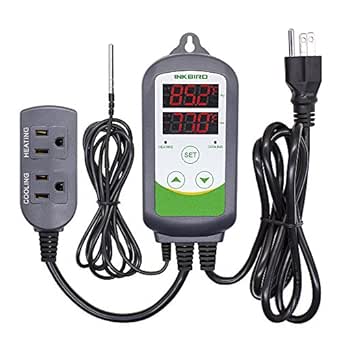 | Best Plug-and-Play Setup | Model: ITC-308 | Type: Digital temperature controller | Relay Outputs: Dual (2-stage) | VIEW ON AMAZON | See Our Full Breakdown |
| Inkbird ITC-308 Digital Temperature Controller Thermostat |  | Best for Batch Protection and Alerts | Display Units: °C or °F | Relays: Dual | Display: Measured and set temperatures | VIEW ON AMAZON | See Our Full Breakdown |
| Inkbird Dual-Stage 12V Digital Temperature Controller |  | Best Low-Voltage and Mobile Pick | Brand: Inkbird | Controller Type: Dual-stage digital temperature controller | Voltage: 12 V | VIEW ON AMAZON | See Our Full Breakdown |
| VIVOSUN Digital Heat Mat Thermostat Controller, 40-108°F, 1000W |  | Best for Heat Mat Fermentation Setups | Control range: 40–108°F | Display range: 32–210°F | Power: 1000W | VIEW ON AMAZON | See Our Full Breakdown |
| WILAWELS Digital Temperature Controller Outlet, 15A/1800W |  | Best for Heating and Cooling Flexibility | Brand: WILAWELS | Model: W01TC06 | Maximum output: 15A/1800W | VIEW ON AMAZON | See Our Full Breakdown |
| fermentation temperature controller | Display | Model |
|---|---|---|
| Inkbird ITC-1000 Dual Stage Di | Celsius/Fahrenheit | ITC-1000 |
| bayite BTC211 Temperature Cont | Dual LCD | — |
| DEWENWILS Smart Temperature Co | High-contrast backlit LCD | — |
| Inkbird Wi-Fi ITC-308 Digital | — | ITC-308 Wi-Fi |
| Inkbird ITC-308 Digital Temper | — | ITC-308 |
| Inkbird ITC-308 Digital Temper | — | ITC-308 |
| BN-LINK Digital Reptile Thermo | LED | — |
| Inkbird ITC-308 Digital Temper | Dual window (measured and set temperature) | ITC-308 |
| Inkbird ITC-308 Digital Temper | Measured and set temperatures | — |
| Inkbird Dual-Stage 12V Digital | — | — |
| VIVOSUN Digital Heat Mat Therm | — | — |
| WILAWELS Digital Temperature C | VA LCD | W01TC06 |
More Details on Our Top Picks
Inkbird ITC-1000 Dual Stage Digital Temperature Controller
The ITC-1000 is the cheapest path into true dual-stage control, managing heating and cooling in one unit, but it arrives as a bare module — no outlets, no cords. That’s the whole tradeoff: you save money by wiring it into your own fermentation chamber or chest freezer build. Compared with the plug-and-play Inkbird ITC-308, it demands more assembly skill, yet gives builders a cleaner, panel-mounted setup with a sensor-failure alarm the STC-1000 clones lack. For a brewer who already owns a drill and a grounded cord, this model makes the most sense; for someone who wants to plug in a fridge tonight, it doesn’t.
Pros:- True dual-stage heating and cooling control at a low cost
- Sensor failure and high-temperature alarms protect your batch
- Celsius/Fahrenheit display switchable on the unit
- Compact panel-mount design suits custom builds
Cons:- Requires user wiring and enclosure — no plug-and-play convenience
- No included outlets or cords, so total project cost rises with accessories
Best for: DIY homebrewers building a keezer or fermentation chamber who can do basic electrical wiring
Not ideal for: Beginners who want an outlet-based controller they can use straight out of the box
- Brand:Inkbird
- Model:ITC-1000
- Voltage:110 Volt
- Control:Dual-stage heating and cooling
- Sensor:NTC sensor probe
- Display:Celsius/Fahrenheit
- Alarms:Sensor failure and high temperature
Our verdict“Buy this only if you’re comfortable wiring your own chamber and want the cheapest reliable dual-stage control.”
bayite BTC211 Temperature Controller, 1650W, 15A
Where the Inkbird ITC-308 tops out around 1100–1200W, the bayite BTC211 handles up to 1650W at 15A, which matters if you’re running a larger heating element alongside a fridge compressor. Setup is genuinely plug-and-play: outlets are built in, and the dual display shows current and set temperatures side by side — something you check constantly during active fermentation. Compressor delay protection prevents short-cycling damage to a fridge, a feature the ITC-308 also carries. The catch is murky power documentation (battery details are unlisted), so confirm specifications before relying on it unattended for long lagering runs.
Pros:- 1650W / 15A load capacity exceeds most competing plug-and-play controllers
- Simultaneous heating and cooling control with built-in outlets
- Compressor delay protection safeguards refrigeration equipment
- Long 9.8ft waterproof probe reaches deep into chambers
Cons:- Confusing power-source documentation with unclear battery requirements
- No remote monitoring or app control
Best for: Fermenters running higher-wattage heating devices who want more headroom than the ITC-308 offers
Not ideal for: Buyers who want remote app monitoring — this unit has no connectivity at all
- Controller type:Plug and play
- Temperature control:Heating and cooling
- Maximum output load:1650W at 110V
- Current:15A
- Temperature range:-58 to 230°F (-50 to 110°C)
- Display:Dual LCD
- Probe:3m (9.8ft) waterproof sensor
- Warranty:1 year
Our verdict“A sensible pick when wattage headroom is the deciding factor and remote features aren’t needed.”
DEWENWILS Smart Temperature Controller, 15A Smart Thermostat with Memory
The DEWENWILS Smart Controller out-features the Inkbird Wi-Fi ITC-308 on paper: six control modes including timer combinations, 0.1°F resolution, and power outage memory that restores settings automatically — genuinely useful during a storm mid-fermentation. App control means you can check a lagering chamber from work rather than walking to the garage. The 15A rating also edges past Inkbird’s 1100W ceiling. The tradeoff is dependence on 2.4 GHz Wi-Fi: if your network drops or you’re in a weak-signal outbuilding, you lose the features that justify choosing it over the cheaper non-connected ITC-308.
Pros:- Six control modes including heating/cooling with timer automation
- Power outage memory restores settings without manual re-entry
- 0.1°F accuracy across a wide -40°F to 210°F range
- 15A capacity handles larger loads than the Inkbird Wi-Fi ITC-308
Cons:- Remote features require a stable Wi-Fi connection
- App ecosystem less established than Inkbird’s brewing-focused community
Best for: Tech-comfortable brewers who want timer automation and remote monitoring of long fermentation runs
Not ideal for: Fermentation spaces far from Wi-Fi routers, where the smart features become dead weight
- Brand:DEWENWILS
- Amperage:15A
- Temperature range:-40°F to 210°F
- Accuracy:0.1°F
- Control modes:Cooling, Heating, Timer, Cooling+Timer, Heating+Timer, OFF
- Connectivity:Wi-Fi app remote control
- Display:High-contrast backlit LCD
- Power outage memory:Yes
Our verdict“The strongest feature set here, provided your fermentation chamber sits within reliable Wi-Fi range.”
Inkbird Wi-Fi ITC-308 Digital Temperature Controller
This version of the ITC-308 adds Wi-Fi app control to the platform brewers already trust, and that’s its entire pitch — remote monitoring through the Inkbird app on iOS and Android. Compared with the standard ITC-308, the workflow is the same plug-and-play dual-relay setup, but you get push notifications from high/low temperature and sensor-malfunction alarms, which is the difference between catching a failed fridge and losing a batch. Against the DEWENWILS, it offers fewer modes and a lower 1100W ceiling, but Inkbird’s app is more proven in brewing circles. Note the 2.4 GHz-only Wi-Fi limitation if your network is 5 GHz.
Pros:- Remote monitoring and control via the established Inkbird app
- Plug-and-play dual relay for heating and refrigeration
- High, low, and sensor malfunction alarms with app notifications
- Temperature calibration plus Celsius/Fahrenheit switching
Cons:- Wi-Fi limited to 2.4 GHz bands only
- 1100W maximum output is lower than the bayite BTC211 or DEWENWILS
Best for: Homebrewers who travel or work long days and want alarm alerts on their phone mid-ferment
Not ideal for: Users on 5 GHz-only networks or those running heaters above the 1100W limit
- Model:ITC-308 Wi-Fi
- Connectivity:2.4 GHz Wi-Fi
- App compatibility:iOS and Android
- Control:Heating and cooling, dual relay
- Maximum output load:1100W at 110V
- Alarms:High temp, low temp, sensor malfunction
- Power source:Corded electric
Our verdict“The safest choice for brewers who want phone alerts and a controller the community already knows well.”
Inkbird ITC-308 Digital Temperature Controller with Heating and Cooling Outlets
The standard ITC-308 earns the top spot by doing the essentials without friction: two pre-wired outlets, one for heating and one for cooling, so a chest freezer and a heat wrap simply plug in. Compared with the ITC-1000, there’s no wiring or enclosure to build; compared with the Wi-Fi model, there’s no app setup or network dependency. Temperature calibration lets you true the probe against a thermometer, and the unit just runs for years — which is why it dominates fermentation forums. The honest drawbacks: 1200W max limits big heating elements, and you still need to supply both the heating and cooling devices themselves, since the controller only switches them.
Pros:- Fully plug-and-play with dedicated heating and cooling outlets
- Adjustable temperature calibration for probe accuracy
- Celsius/Fahrenheit display suits any user preference
- Versatile enough for fermentation, greenhouses, and reptile habitats
Cons:- Requires you to supply separate heating and cooling equipment
- Probe placement is manual and affects control accuracy
- No remote monitoring capability
Best for: First-time chamber builders and everyday brewers who want reliable dual control with zero setup friction
Not ideal for: Anyone wanting remote monitoring or running heaters above 1200W
- Model:ITC-308
- Input voltage:110V
- Maximum power:1200W
- Control modes:Heating and cooling
- Temperature display:Celsius or Fahrenheit
- Calibration:Adjustable
Our verdict“If you just want a fermentation temperature controller that works out of the box and stays out of your way, this is the one to buy.”
Inkbird ITC-308 Digital Temperature Controller
This version of the ITC-308 stands out for brewers who need both heating and cooling wired into a single fermentation chamber — a heating wrap on one outlet, a fridge or freezer on the other. Compared with the BN-LINK thermostat, which only switches heating devices, this model keeps a lager or saison stable through swings from day to night. The compressor delay is the feature that matters most here: rapid cycling kills fridge compressors, and this setting spaces out cooling calls to protect the equipment you already own. The included probe and high/low alarms mean a failed fermentation gets flagged before it ruins a batch.
Pros:- Simultaneous heating and cooling control from one unit
- Compressor delay protects refrigeration equipment from short cycling
- High and low temperature alarms catch fermentation failures early
- Switches between Celsius and Fahrenheit for flexible reading
Cons:- 1100W load ceiling limits which fridges and heaters it can safely run
- Wired relay setup requires routing cords into your fermentation chamber
Best for: Homebrewers running a fridge or freezer fermentation chamber with a heat source
Not ideal for: Anyone running gear above 1100W, like large chest freezers with big compressors
- Brand:Inkbird
- Model:ITC-308
- Maximum Output Load:1100 W at 110 V
- Temperature Units:Celsius or Fahrenheit
- Alarms:High and low temperature
- Compressor Delay:Built-in
- Wiring:4-core output and 3-core input
- Included Components:Controller, temperature probe, manual
Our verdict“The safest default pick for brewers who want both sides of temperature control in one plug-and-play box.”
BN-LINK Digital Reptile Thermostat Temperature Controller, 40–108°F, 1000W
If your fermentation setup lives in a cold basement and only ever needs heat — a seedling mat under a carboy or a heat wrap on a vessel — this BN-LINK thermostat does that one job for less than any dual-relay rival. The 40–108°F range covers nearly every ale and lager fermentation band, and the LED display with power and heating indicators makes it obvious at a glance whether the system is working. The tradeoff versus the Inkbird ITC-308 lineup is fundamental: there is no cooling relay, so a warm garage or summer fermentation is out of reach. For winter brewing in a chilly space, though, this is the simpler and cheaper path.
Pros:- Straightforward push-button setup with no relay wiring to figure out
- Clear LED display with separate power and heating indicator lights
- ETL-listed for safety on heating devices up to 1000W
- Works with heat mats, wraps, and lamps across hobbies beyond brewing
Cons:- Heating only — no cooling output at all
- No compressor delay, so it should never be paired with refrigeration
- 1000W load cap is lower than 15A alternatives like the bayite BTC211
Best for: Cold-space fermenters who only need to add heat, like a basement brewer with a heat wrap
Not ideal for: Warm-climate brewers who need to cool a fermenter or run a fridge compressor
- Temperature Range:40–108°F
- Maximum Load:1000W, 8.3A
- Voltage:120VAC, 60Hz
- Probe Length:4.92 ft
- Power Cord:3.94 ft
- Display:LED
- Safety Listing:ETL listed
Our verdict“A smart save if your fermentation problem is cold, not warm — skip it the moment cooling enters the picture.”
Inkbird ITC-308 Digital Temperature Controller Outlet Thermostat, 2-Stage, 1100W with Sensor
What separates this listing of the ITC-308 from bare-controller options like the Inkbird ITC-1000 or bayite BTC211 is the plug-and-play outlet design — no wiring terminals, no electrician, no guessing. You plug your fridge and heater straight into the unit and set your target on the dual display window, which shows measured and set temperatures side by side. For a first fermentation chamber build, that simplicity is worth a lot; hardwired controllers offer more flexibility but demand comfort with 110V wiring. The 1100W ceiling is the same constraint across the ITC-308 family, so a larger freezer may still need the 15A bayite instead. Compared with the BN-LINK, this covers the full heating-plus-cooling workflow in one purchase.
Pros:- True plug-and-play — no wiring knowledge required
- Dual relay runs heating and cooling equipment simultaneously
- Dual display window shows actual and target temperature at once
- Explicitly rated for brewing, kegs, curing, and breeding applications
Cons:- 1100W limit excludes higher-power freezers and heaters
- Fewer adjustable parameters than terminal-wire controllers like the ITC-1000
Best for: First-time fermentation chamber builders who want zero wiring and instant setup
Not ideal for: Tinkerers who want configurable relays or higher-power loads beyond 1100W
- Model:ITC-308
- Type:Digital temperature controller
- Relay Outputs:Dual (2-stage)
- Maximum Output Load:1100W (110V)
- Temperature Units:Celsius / Fahrenheit
- Display:Dual window (measured and set temperature)
- Installation:Plug and play
- Applications:Brewing, kegs, fridges, curing, breeding, growing
Our verdict“The easiest on-ramp to serious fermentation temperature control — trade maximum flexibility for setup you can finish in five minutes.”
Inkbird ITC-308 Digital Temperature Controller Thermostat
This ITC-308 variant earns its spot for the most complete alarm package in the lineup: high temperature, low temperature, and sensor malfunction alerts. That last one matters more than brewers expect — a knocked-loose probe silently reads a false temperature, and without a sensor alarm the controller happily bakes or freezes a batch based on bad data. Compared with the plug-and-play ITC-308 listing, this unit also offers an adjustable compressor delay, letting you tune the protection window to your specific fridge rather than accepting a fixed value. The dual relay layout and dual temperature readout match the rest of the ITC-308 family, and the same 1100W ceiling applies, so very large chambers should still look at the 15A bayite BTC211.
Pros:- Sensor malfunction alarm catches failed or displaced probes before they ruin a batch
- Adjustable compressor delay lets you match protection to your fridge
- High and low temperature alarms cover both failure directions
- Dual relays and dual temperature readout for full heating and cooling control
Cons:- 1100W maximum load limits compatibility with larger freezers
- More settings to learn than simpler heating-only thermostats like the BN-LINK
Best for: Brewers fermenting long lagers or sour beers who can’t check the chamber daily
Not ideal for: High-power setups above 1100W that need a heavier-duty relay
- Display Units:°C or °F
- Relays:Dual
- Display:Measured and set temperatures
- Alarms:High temp, low temp, sensor malfunction
- Maximum Output Load:1100 W at 110 V
- Adjustable Settings:Temperature and compressor delay
Our verdict“The ITC-308 to buy when an unattended fermentation is too valuable to lose to an unnoticed probe failure.”
Inkbird Dual-Stage 12V Digital Temperature Controller
This is the outlier of the roundup: a 12V dual-stage controller built for off-grid and mobile setups rather than wall outlets. Where the standard ITC-308 assumes household power, this one runs from a car battery or 12V system, making it the only sensible choice for fermenting in a van, camper, or solar-powered shed with 12V coolers and fans. The adjustable return differential and temperature calibration give it more tuning depth than the BN-LINK heating-only thermostat, and it still switches automatically between heating and cooling. The compromises are real: it controls low-voltage devices, not household fridges, and the Fahrenheit-only display may annoy metric-minded brewers used to the dual-unit ITC-308 models.
Pros:- Runs on 12V power for battery, solar, and vehicle setups
- Automatic switching between heating and cooling modes
- Adjustable return differential and temperature calibration for fine control
- High/low temperature and sensor error alarms protect unattended ferments
Cons:- Cannot directly control household 110V fridges or freezers
- Fahrenheit-only display with no Celsius option
- Cooling output delay is optional and must be configured rather than built in
Best for: Van lifers, off-grid brewers, and solar-shed setups running 12V coolers or heaters
Not ideal for: Anyone with standard household outlets and fridges — the 110V ITC-308 models fit better
- Brand:Inkbird
- Controller Type:Dual-stage digital temperature controller
- Voltage:12 V
- Relay Outputs:2
- Temperature Units:Fahrenheit
- Additional Features:Calibration, optional cooling delay, high/low and sensor alarms
- Applications:12V coolers, heaters, fermenters, incubators, greenhouses, fans
Our verdict“A niche but genuinely useful controller for fermentation away from wall power — everyone else should stick with the 110V ITC-308 family.”
VIVOSUN Digital Heat Mat Thermostat Controller, 40-108°F, 1000W
The VIVOSUN Digital Heat Mat Thermostat is a focused choice for brewers who ferment in a vessel warmed by a heat mat and need straightforward temperature control. Its probe tracks the fermentation area while the controller switches the mat to maintain a setpoint, and the 40–108°F control range covers common ale fermentation temperatures. Compared with the Inkbird ITC-308 models, this unit is built around heat mat use rather than offering separate heating and cooling outlets, so it suits a simpler setup but cannot actively cool a fermenter. The three-button interface and Fahrenheit/Celsius display keep setup approachable. Its 1000W rating and North American outlet compatibility limit where it can be used, and the wider 32–210°F display range may be confusing because those extremes are outside its control range.
Pros:- 40–108°F control range covers common fermentation temperature targets
- Sensor probe monitors temperature at the fermenter
- Three-button controls and Fahrenheit/Celsius switching keep operation simple
- Hanging tab, wall mount, and angled socket support a tidier heat mat setup
Cons:- Controls a heat mat but does not provide active cooling
- North American outlet compatibility limits use in other regions
- The display range extends well beyond the temperatures it can control
Best for: Home brewers using a heat mat for one fermenter who want a simple controller for fermentation temperatures.
Not ideal for: Brewers who need active cooling, control of both heating and cooling, or compatibility beyond North American outlets.
- Control range:40–108°F
- Display range:32–210°F
- Power:1000W
- Controls:3 buttons
- Temperature units:Fahrenheit and Celsius
- Compatibility:Any heat mat; North American outlets
- Included:Sensor probe, hanging tab, wall mount
Our verdict“Choose the VIVOSUN if you need a simple heat mat controller for a single fermenter and do not need cooling.”
WILAWELS Digital Temperature Controller Outlet, 15A/1800W
The WILAWELS W01TC06 stands out for fermenters who want one plug-in controller to manage heating and cooling. Its stated range of -40°F to 210°F leaves room for fermentation schedules beyond the narrow band of a heat mat thermostat such as the VIVOSUN, while the 15A/1800W output supports higher-load equipment. Four timer modes add scheduling options, though the supplied product details do not explain how those modes work or identify included probes or separate outlets. That makes it harder to judge the exact setup than with the Inkbird ITC-308, whose heating and cooling outlet arrangement is specified. The VA LCD provides a readout, but buyers should confirm the connection and sensor details suit their equipment before choosing it for a fermentation chamber.
Pros:- Heating and cooling control offers more flexibility than heat-only controllers
- 15A/1800W maximum output supports higher-load devices
- -40°F to 210°F stated operating range accommodates a broad range of temperature settings
- Four timer modes provide scheduling options
Cons:- Product details do not specify whether a sensor probe is included
- Timer mode behavior is not described
- Outlet configuration is not stated, making equipment compatibility harder to assess
Best for: Home brewers who want a plug-in controller with heating and cooling support and need a higher stated output capacity.
Not ideal for: Buyers who need clearly documented probe, outlet, and timer details before wiring a fermentation chamber.
- Brand:WILAWELS
- Model:W01TC06
- Maximum output:15A/1800W
- Temperature range:-40°F to 210°F
- Control modes:Heating and cooling
- Timer modes:4
- Display:VA LCD
- Unit count:1
Our verdict“Consider the WILAWELS if you need heating and cooling in a high-capacity plug-in controller and can verify its connections and sensor setup.”

How We Picked
I compared the 12 listed controllers by how directly they suit fermentation temperature management: whether they can control heating and cooling, how the sensor and outlets fit a typical chamber, and whether setup calls for plug-in use or electrical wiring. I also weighed practical usability features such as Wi-Fi access, memory, stated load capacity, and the narrower temperature-control purpose of heat-mat and reptile thermostats. These factors matter because stable readings alone do not help if a controller cannot switch the equipment a brewer uses.
The ranking favors versatile, accessible control for a typical home fermentation chamber. The Wi-Fi Inkbird ITC-308 leads for combining remote monitoring with dual-stage control; standard ITC-308 versions follow as straightforward local alternatives, with the smart DEWENWILS and higher-capacity plug-in options serving different priorities. Wired or 12V models rank lower for general use because they demand a more specific setup, and heat-mat thermostats rank lower because their stated use is more limited. Product descriptions do not establish every technical difference among the near-identical ITC-308 listings, so I treat them as close variants and advise checking the exact specifications before purchase.
| fermentation temperature controller | Model |
|---|---|
| Inkbird ITC-1000 Dual Stage Di | ITC-1000 |
| bayite BTC211 Temperature Cont | — |
| DEWENWILS Smart Temperature Co | — |
| Inkbird Wi-Fi ITC-308 Digital | ITC-308 Wi-Fi |
| Inkbird ITC-308 Digital Temper | ITC-308 |
| Inkbird ITC-308 Digital Temper | ITC-308 |
| BN-LINK Digital Reptile Thermo | — |
| Inkbird ITC-308 Digital Temper | ITC-308 |
| Inkbird ITC-308 Digital Temper | — |
| Inkbird Dual-Stage 12V Digital | — |
| VIVOSUN Digital Heat Mat Therm | — |
| WILAWELS Digital Temperature C | W01TC06 |
Factors to Consider When Choosing Fermentation Temperature Controller
Choosing a controller starts with the equipment and fermentation space you already have. These broader checks can prevent a mismatch that product names alone may not reveal.
Decide whether you need heating, cooling, or both
Think about the lowest and highest temperatures your space reaches across the seasons, then list the devices you would use to correct each condition. A dual-stage controller can coordinate a heater and a cooling device, which is useful when ambient swings make one-direction control unreliable. A heating-only thermostat may suit a consistently cool room or a modest heat-mat setup, but it cannot cool a warm chamber. Avoid assuming that two sockets mean two independently suitable outputs; check how the controller assigns and switches them. Also confirm that your cooling appliance can tolerate the controller’s switching behavior. Matching control stages to the room’s real temperature problems is more useful than buying extra capability you will never use.
Match the controller to your electrical setup
Plug-in controllers are generally easier to place into an existing home setup, while a wired controller requires suitable electrical knowledge and an installation compatible with its instructions. Before buying, check the supply voltage, plug type, and maximum load for each device you plan to connect. A stated wattage or amperage limit applies to the controller’s electrical capacity; it does not indicate how precisely it will regulate fermentation. Leave appropriate capacity for the actual equipment and avoid connecting loads that exceed the rating. If the product listing is unclear about outlet layout or supported voltage, treat that uncertainty as a reason to verify the manual. A controller that fits your equipment safely is a better choice than one selected by feature count alone.
Place the probe where it reflects the ferment
The controller can only react to the temperature its sensor detects, so probe placement affects the result. Air temperature in a chamber may change faster than the liquid temperature of an active fermentation. A probe attached to a fermenter under insulation can offer a closer reading of the vessel than a probe hanging near a heater or cold wall. Keep the sensor away from direct heat, cooling airflow, and spots that do not represent the fermenter. Check how the probe is mounted and whether its cable reaches the intended location. A well-placed sensor can matter more than adding remote features to a controller.
Treat connectivity as a monitoring choice
Wi-Fi can make it easier to check readings or settings when you are away from the fermentation space, but it does not remove the need for a correctly configured controller. Consider whether your brewing routine benefits from remote checks or whether a local display is enough. Smart functions and memory may help preserve settings after interruptions, though their exact behavior should be confirmed in the product documentation. A connected controller also depends on a suitable network and app support. If you prefer a simple setup, a conventional outlet model can reduce reliance on extra software. Pay for connectivity when remote access solves a real monitoring problem for you.
Check the temperature range and intended use
Compare the controller’s stated range with the temperatures your fermentation process needs, including any cold-side steps. A range designed around reptile or heat-mat applications may be adequate for a narrow heating task but may not suit broader chamber control. Range alone is not the same as accuracy, sensor response, or control stability, so consult the manual for those details when they matter to your process. Consider where the controller will sit and whether its display and probe setup work in that environment. Avoid choosing by a broad-looking range if the device lacks the output type your equipment needs. The intended application can reveal a mismatch that a headline temperature span hides.
Choose between outlet convenience and a custom installation
An outlet controller is appealing when you want to connect compatible equipment without building a control panel. A wired dual-stage unit can make sense for brewers who already have an enclosure or are comfortable designing a dedicated installation. The tradeoff is convenience against installation flexibility: plug-in units limit you to their provided outlets, while wired designs place more responsibility on the user. A 12V controller adds another compatibility question because it is intended for low-voltage systems rather than ordinary mains-powered appliances. Sketch the full setup, including the chamber, heater, cooling source, and power supply, before ordering. This simple check can rule out an otherwise attractive model.
Frequently Asked Questions
Can one temperature controller run both a heater and a refrigerator?
It can if the controller is designed for dual-stage heating and cooling and its outputs match the equipment. The Inkbird ITC-308 family in this roundup is positioned around heating and cooling outlets, while heat-mat thermostats are narrower heating tools. Check the controller’s load limits and the refrigerator’s electrical requirements before connecting it. Also verify how the device handles switching and delays, since cooling equipment may need protection from rapid restarts. If your setup only needs warmth, a dual-stage model may add capability you do not need.
Is a Wi-Fi controller worth choosing over a standard plug-in model?
Wi-Fi is useful when you want to check fermentation conditions or controller status away from the brew space. It does not by itself improve temperature control, so sensor placement and correctly matched heating or cooling equipment still matter. The Inkbird Wi-Fi ITC-308 is the remote-monitoring option among these picks, while standard ITC-308 versions keep the experience more local. Check app and network requirements before deciding. If you regularly tend your ferment at home, a clear local display may be all you need.
Should I measure the chamber air or the fermenting liquid?
Neither reading is universally right; the useful measurement depends on what you want the controller to regulate. Chamber air reacts quickly to heating and cooling, while the fermenting liquid can lag and better reflect the vessel’s temperature. A probe secured to the fermenter under insulation can help approximate the liquid’s temperature without placing the sensor in the brew. Keep the probe away from direct heat or cold airflow, which can cause unnecessary switching. Use a consistent placement across batches so your settings remain comparable.
Can I use a reptile or heat-mat thermostat for fermentation?
A heating-oriented thermostat may work for a setup that only needs added warmth, provided its range, probe, and electrical rating suit the application. The BN-LINK and VIVOSUN models here are described for reptile or heat-mat control, so they are less versatile choices for a chamber that also needs cooling. They may be a reasonable fit for a small, warm fermentation space with no cooling requirement. Check whether the temperature range covers your process and whether the sensor can be placed appropriately. For year-round chamber control, a dual-stage option is usually a closer match.
What should I verify before buying one of the similar Inkbird ITC-308 listings?
Compare the exact listing and manual for outlet arrangement, voltage, maximum load, included probe, and whether Wi-Fi is present. Several products in this roundup use nearly identical ITC-308 naming, while their descriptions state different capacities or features. Do not assume that a suffix or a small wording change guarantees a meaningful hardware difference. Confirm that the plugs match your heater and cooling equipment, and that the combined use fits the controller’s limits. If a listing leaves a specification unclear, check the manufacturer’s documentation before ordering.
Conclusion
For most home brewers managing a chamber with heating and cooling, I would start with the Inkbird Wi-Fi ITC-308 as the best overall pick, especially when remote checks are useful. The standard Inkbird ITC-308 is the better value direction for buyers who want dual-stage outlet control without Wi-Fi, while the DEWENWILS Smart Temperature Controller is the smart-feature alternative. For beginners, I would favor a clearly specified plug-in model over the wired ITC-1000, which better suits someone comfortable with installation. Choose BN-LINK or VIVOSUN for a limited heating task, and consider the 12V Inkbird only when your setup specifically uses low-voltage equipment. Before choosing among the closely named ITC-308 listings, verify the exact capacity and included components against your equipment.
NFL season / tailgating Picks
team gear
As an affiliate, we earn on qualifying purchases.