

Get kitchen staples and gadgets delivered free with Prime
- Fast, free delivery on millions of items
- Prime Video, Amazon Music and more included
- Member-only deals all year
The Real Decision: Footprint Versus Function
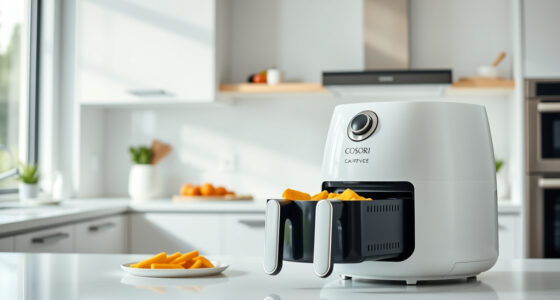
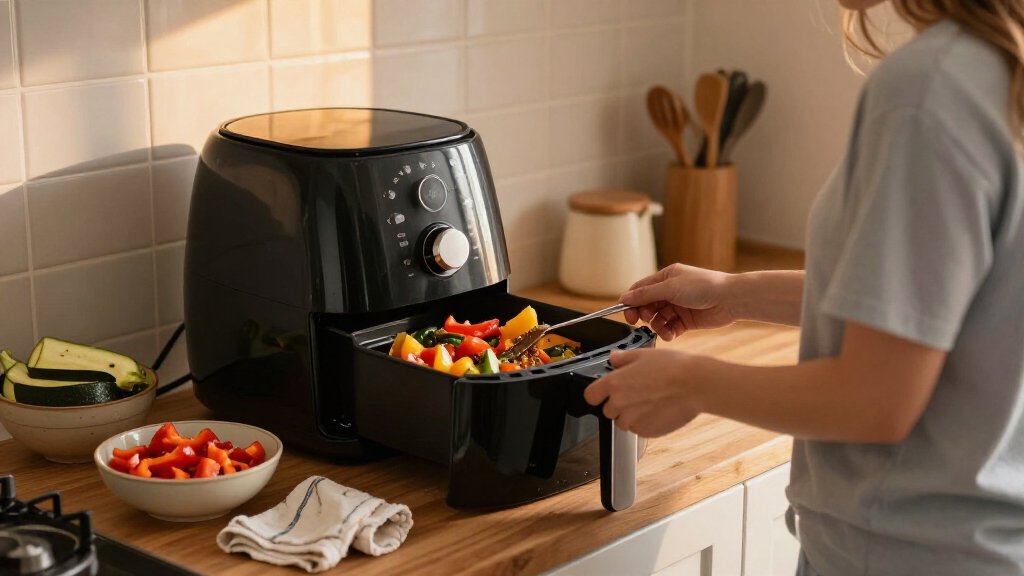
When your kitchen counter is measured in spare inches rather than square feet, an air fryer forces a genuinely difficult tradeoff. The two options most small-space buyers narrow down to are the compact pod-style air fryer (typically 2 to 3 quarts, the tall narrow egg shape from brands like Dash, Chefman, and Instant’s smallest models) and the mid-size basket air fryer (5 to 6 quarts, the wider squat design from Ninja, Cosori, and Philips). These are not just different sizes of the same product; they represent two different philosophies about what a small kitchen needs.
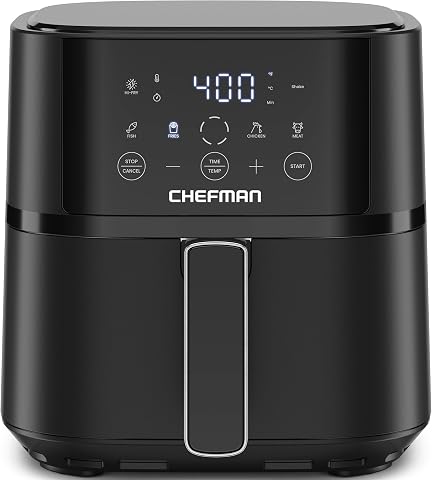
Chefman 4-Quart Compact Air Fryer with Hi-Fry Technology
- ✔ Capacity: 4 quarts
- ✔ Power: 1500 W
- ✔ Controls: Digital touchscreen with 4 presets

Chefman 2-Quart Digital Mini Air Fryer
- ✔ Capacity: 2 quarts
- ✔ Power: 900 watts
- ✔ Dimensions: 10 x 10 x 8.3 inches

Cosori TurboBlaze 9-in-1 Air Fryer, 6 Qt, PFAS-Free Ceramic Coating
- ✔ Capacity: 6 qt
- ✔ Functions: 9-in-1
- ✔ Fan speeds: 5
The pod wins the space argument outright. It takes up roughly the footprint of a large mug, slides into a cabinet between uses, and sips electricity. But that convenience comes at a real cost: capacity. Two portions of fries, a single chicken breast, four wings at a time. The mid-size basket occupies three to four times the counter space but can roast a whole small chicken, cook four servings at once, and handle the sheet-pan-style recipes that make an air fryer feel like a second oven rather than a snack gadget.
The decision, then, is less about which air fryer is better made and more about an honest answer to one question: are you cooking for one or two people most nights, or do you regularly feed three or more? This guide compares the two formats across the criteria that actually matter in a cramped kitchen: footprint, storage, usable capacity, cooking performance, versatility, energy use, cleaning, and price. By the end, you should know which format fits your household, your counter, and your cooking habits.
Chefman 4-Quart Compact Air Fryer with Hi-Fry Technology
The Chefman 4-Quart Compact lands in the middle of this group in the way small-kitchen shoppers often need: it is larger than a personal appliance, yet avoids the 6-quart capacity of the Cosori. Its stated capacity is suited to two to four people, giving couples or small households more flexibility than the 2-quart Mini. The tradeoff is that no dimensions are provided, so we cannot compare its actual counter footprint precisely with the Mini’s listed 10 x 10 inches.Its Hi-Fry finish increases the temperature to 450°F for the final two minutes, which is intended to add crispness without a separate appliance or extra cooking step. Four touchscreen presets and an audible halfway reminder make routine cooking approachable, while automatic shutoff helps when a busy kitchen pulls attention elsewhere. Compared with the Cosori, this Chefman has fewer described cooking modes and less capacity, but that smaller capacity is precisely why it is the more balanced fit for limited space.Cleanup is straightforward on paper: both the basket and rack are dishwasher-safe. The main limitation is serving scale. Households regularly cooking for more than four people may prefer the Cosori’s 6-quart basket, while solo cooks with almost no storage to spare can save more room with the Mini. We would choose this model when one appliance needs to cover everyday meals for a small household without prioritizing maximum capacity.
Pros:
- 4-quart capacity is sized for two to four people
- Hi-Fry setting raises heat to 450°F for the final two minutes
- Dishwasher-safe basket and rack simplify cleanup
- Halfway reminder and automatic shutoff support everyday use
Cons:
- Capacity may be limiting for larger households
- No product dimensions are supplied to confirm its exact footprint
- No cooking accessories are mentioned
Best for: Couples and small households who want room for two to four servings while keeping capacity below a full-size 6-quart model.
Not ideal for: Solo cooks with very little counter or cabinet space, or larger households that routinely need to cook family-size batches.
Bottom line: We rank the Chefman 4-Quart first because it offers the most convincing balance of small-kitchen capacity, useful crisping, and easy cleanup.
“We rank the Chefman 4-Quart first because it offers the most convincing balance of small-kitchen capacity, useful crisping, and easy cleanup.”
Chefman 2-Quart Digital Mini Air Fryer
When every inch of counter or cabinet space matters, the Chefman 2-Quart Mini is the easiest pick in this comparison to assess: its listed dimensions are 10 x 10 x 8.3 inches, and it weighs 5.9 pounds. Its 2-quart basket is meant for one or two people, so the compact form has a direct consequence: we should expect less room for a meal than with either the 4-quart Chefman or 6-quart Cosori. For a solo cook, that can be a sensible space-for-capacity exchange; for frequent shared meals, it can mean cooking in batches.The touch controls, adjustable temperature up to 400°F, and shake reminder keep the feature set focused on routine cooking. The reminder is particularly useful in a small kitchen where the appliance may be tucked away and not always in view. Dishwasher-safe basket and rack reduce cleanup effort, and automatic shutoff adds reassurance. Compared with the 4-quart Chefman, however, it gives up the higher 450°F maximum and Hi-Fry finish; compared with the Cosori, it has fewer listed functions and a much smaller cooking capacity.This is the most space-oriented recommendation, not the most versatile one. Its 900-watt output and 2-quart size suit modest portions, but the supplied details do not describe capacity beyond the quart figure or identify included accessories. We would favor it for a dorm, studio, or compact shared kitchen where storage ease matters more than preparing several portions together. Shoppers who regularly cook for guests should move up to the 4-quart model.
Pros:
- Listed dimensions are compact at 10 x 10 x 8.3 inches
- 2-quart capacity is suited to one or two people
- Shake reminder helps prompt more even cooking
- Dishwasher-safe parts and automatic shutoff simplify routine use
Cons:
- 2-quart capacity can require batches for shared meals
- Maximum temperature is lower than the 450°F Chefman 4-Quart and Cosori
- The feature set and cooking room are more limited than the larger picks
Best for: One-person households, students, or anyone with a genuinely limited counter and cabinet footprint who cooks small portions.
Not ideal for: Families, frequent hosts, or anyone who wants to prepare multiple generous servings in one batch.
Bottom line: We recommend the Chefman Mini when reclaiming counter and storage space matters more than cooking a full meal for several people at once.
“We recommend the Chefman Mini when reclaiming counter and storage space matters more than cooking a full meal for several people at once.”
Cosori TurboBlaze 9-in-1 Air Fryer, 6 Qt, PFAS-Free Ceramic Coating
The Cosori TurboBlaze takes a different approach to a small kitchen: rather than minimize the appliance, it aims to replace more cooking tasks with one larger unit. Its 6-quart capacity is the biggest here, and the nine-in-one functions, five fan speeds, and 90°F to 450°F temperature range offer more flexibility than either Chefman. That can make it more practical for households that do not have room for several countertop appliances, provided they can spare the space for this one.The distinction matters because this is not the compact pick by physical footprint. The product details describe a wide, deep basket, but provide no dimensions, so we cannot quantify the space it needs. Compared with the 4-quart Chefman, the Cosori offers more room for family meals and a broader set of cooking adjustments; compared with the Mini, it is far less suited to a kitchen where storage is the first concern. Its ranking reflects that narrower fit: useful for small homes needing larger batches, but not the default choice for the smallest counters.Practical touches include a PFAS-free ceramic-coated basket and crisper tray, both dishwasher-safe, plus operation below 53 dB. The manufacturer also describes reduced oil use of up to 95% versus traditional deep frying, based on lab analysis; that claim is a comparison to deep frying and does not establish a result for every recipe. The principal drawback remains physical size. We would choose it when batch capacity and versatility can consolidate cooking needs, and skip it when a large basket would dominate the counter or be awkward to store.
Pros:
- 6-quart basket supports larger and family-size batches
- Nine functions, five fan speeds, and a broad temperature range
- PFAS-free ceramic-coated basket and crisper tray are dishwasher-safe
- Designed for operation below 53 dB
Cons:
- The 6-quart size may use substantial counter or cabinet space
- No dimensions are provided for a precise footprint comparison
- Up to 95% less oil claim is based on lab analysis
Best for: Small households that cook family-size portions or want a versatile main countertop cooker and have room to store a 6-quart appliance.
Not ideal for: Solo cooks, very small kitchens with little cabinet clearance, or anyone prioritizing the smallest possible countertop appliance.
Bottom line: We place the Cosori third for small-kitchen fit, while recommending it to households that need its larger capacity and can accommodate the extra space.
“We place the Cosori third for small-kitchen fit, while recommending it to households that need its larger capacity and can accommodate the extra space.”
As an Amazon Associate we earn from qualifying purchases.
At a Glance
| Criteria | Compact pod-style air fryer (2–3 quart) | Mid-size basket air fryer (5–6 quart) | Winner |
|---|---|---|---|
| Countertop footprint | Very small — roughly 8×8 inches, mug-sized base | Large — roughly 12×12 inches or more, needs permanent counter space | A |
| Storage practicality | Fits most cabinets and shelves easily | Too bulky for many cabinets; usually lives on the counter | A |
| Usable capacity | 1–2 portions per batch | 3–5 portions per batch, whole small chicken | B |
| Versatility and recipe range | Limited — small items only, batch cooking required | Wide — roasts, bakes, multi-component meals in one go | B |
| Cooking performance | Fast for small loads, less even on crowded baskets | More even airflow with larger baskets, better browning | B |
| Energy consumption | Lowest draw, typically 800–1,200W | Higher draw, typically 1,500–1,700W, but fewer total cycles | Depends |
| Cleaning effort | Quick, small parts fit any sink | Bigger basket, more surface to wash | A |
| Price | $25–$60 typical | $80–$180 typical | A |
Key Differences
What Actually Separates These Two Formats
The first and most visible difference is physical. A 2–3 quart pod occupies about as much counter as a French press; a 5–6 quart basket claims the space of a toaster oven and then some, because you also need clearance above and behind for ventilation. In a small kitchen this is not a minor ergonomic detail — it is often the deciding factor. If the mid-size unit cannot live permanently on your counter, and your cabinets cannot swallow it, the format simply does not work in your home regardless of how well it cooks. Measure before buying anything: the listed footprint understates the real requirement once you add the recommended inches of clearance on all sides.
The second difference is capacity, and it is larger than the quart numbers suggest. A 5-quart basket does not hold twice what a 2.5-quart pod holds in practical terms; because of basket shape and the need for air circulation around food, the real-world jump is closer to three times the usable food volume. In a pod you cook a single layer of a few items; in a mid-size basket you can fit a whole chicken thigh dinner with vegetables, or enough fries and nuggets for four people in one cycle. Households that try to make a pod feed a family end up batch cooking — running three consecutive cycles while the first portions go cold. That frustration is the single most common reason small air fryers get abandoned in a cabinet.
The third difference is subtle but real: cooking quality. Larger baskets generally allow better airflow around food, which produces more even browning and crisping, while cramped pods can steam food near the center if overloaded. Mid-size models also tend to get better temperature controls, more presets, and more consistent heating elements simply because manufacturers put their better engineering into their flagship sizes. The pod’s counterpoint is speed and economy for genuinely small loads — it preheats almost instantly and finishes a single portion faster than a big unit would.
Detailed Comparison
Countertop footprint (Compact pod-style air fryer (2–3 quart) wins — major)
This is the pod’s home turf and the gap is major. A 2–3 quart pod needs roughly an 8×8 inch patch of counter with modest overhead clearance, and many models are light enough to shuffle aside when not in use. A 5–6 quart basket demands 12×12 inches or more, plus several inches of ventilation space on all sides, and weighs enough that moving it daily becomes a chore you will stop doing within a month. In a kitchen with under four feet of usable counter, the mid-size unit will dominate the workspace. If you cannot dedicate that space permanently, the format decision is already made for you.
Storage practicality (Compact pod-style air fryer (2–3 quart) wins — major)
The pod wins again, and this is often underweighted by buyers. A compact pod fits inside most standard upper cabinets, a deep drawer, or even a shelf in a pantry closet, which means it can genuinely live off the counter. A mid-size basket rarely fits any cabinet in a small kitchen — its depth plus the drawer mechanism makes it one of the bulkiest small appliances you can own. Most owners concede and let it live permanently on the counter, which then displaces a toaster, a knife block, or prep space. If your strategy is ‘store it and pull it out when needed,’ only the pod realistically supports that habit.
Usable capacity (Mid-size basket air fryer (5–6 quart) wins — major)
Here the mid-size basket wins decisively, and the practical gap exceeds the raw quart numbers. A 2–3 quart pod comfortably handles one or two portions: two chicken breasts, a single serving of fries, four wings. Crowding it degrades results because air fryers depend on circulation. A 5–6 quart basket handles three to five portions, a whole small chicken, or a full one-pan dinner. For anyone cooking for more than two people, or anyone who batch-cooks for the week, this difference is the difference between a daily tool and a frustrating appliance that runs in shifts while earlier batches cool.
Versatility and recipe range (Mid-size basket air fryer (5–6 quart) wins — moderate)
The mid-size format opens up recipes the pod physically cannot attempt: whole roast chickens, small casseroles, reheated pizza slices at full size, doughnuts, block-shaped baked goods, multi-component sheet-pan meals. The pod is limited to small cut pieces and single items. Mid-size models also more often include accessories — racks, skewers, parchment inserts — designed for layered cooking. The gap is moderate rather than major if your actual use case is frozen snacks, reheating leftovers, and single-protein dinners, which covers a large share of real-world air fryer use. Be honest about your cooking ambitions here; many buyers pay for versatility they never touch.
Cooking performance (Mid-size basket air fryer (5–6 quart) wins — moderate)
Mid-size baskets generally deliver more even results because food sits in a shallower, wider layer with better airflow, and because manufacturers reserve their better thermostats and fan designs for these flagship sizes. Pods can brown unevenly when loaded near capacity and run hot near the element. However, for the small single-portion loads the pod is designed for, performance is genuinely good and often faster thanks to a smaller cavity to heat. The advantage to B is real but moderate — noticeable on crowded or delicate loads, negligible on a handful of frozen fries.
Energy consumption (minor difference)
On paper the pod draws less power (typically 800–1,200 watts versus 1,500–1,700), but total energy depends on how many cycles you run. Cooking one portion in a pod uses less energy than heating a big basket for the same portion. Cooking four portions in one big-basket cycle uses less energy than four pod cycles. The winner genuinely depends on household size: singles and couples save with the pod; families save with the basket. The absolute dollar amounts are small either way — do not let energy arguments drive this decision.
Cleaning effort (Compact pod-style air fryer (2–3 quart) wins — minor)
The pod is faster to clean simply because there is less of it: the small basket and drawer fit in any sink and many are dishwasher-safe. Mid-size nonstick baskets take more scrubbing area and their coating wears with use, though square footage alone is the main difference. Neither format is painful to clean compared to a full oven. This is a minor point that leans A, worth noting only if you already resent washing dishes.
Price (Compact pod-style air fryer (2–3 quart) wins — moderate)
Pods typically run $25 to $60 and mid-size baskets $80 to $180, though frequent sales compress this range. The pod is the clear budget winner, and because it has fewer features to break, cheap pods tend to hold up fine. Paying two to three times more for the basket buys capacity and versatility, not better build quality per dollar. If budget is the constraint, the pod delivers a larger share of the air fryer experience for the money — provided capacity was never a need.
Compact pod-style air fryer (2–3 quart): Pros and Cons
Pros:
- Tiny footprint — fits counters and cabinets other appliances cannot
- Cheapest way into air frying, often under $50
- Very fast preheat and quick single-portion cooking
- Effortless cleaning — small parts, any sink
- Low power draw, fine for old wiring or dorms
Cons:
- One to two portions per batch; families will batch-cook constantly
- Cannot fit whole chickens, casseroles, or full-size items
- Uneven results when crowded or overloaded
- Often basic controls and fewer presets
- Growth risk — upgrade urge if your household or ambitions grow
Mid-size basket air fryer (5–6 quart): Pros and Cons
Pros:
- Cooks three to five portions in a single cycle
- Handles whole chickens, casseroles, and one-pan meals
- Generally more even airflow and better browning
- Better controls, presets, and accessory ecosystems
- One-batch cooking for families means it actually gets used daily
Cons:
- Dominates a small counter — needs permanent space
- Too bulky for most small-kitchen cabinets
- Higher price, typically $80 to $180
- More surface area to clean
- Wasted capacity and energy for solo cooks
Who Should Choose What
Choose Compact pod-style air fryer (2–3 quart) if:
- You cook for one or two people the majority of the time
- Your usable counter space is under three feet or already crowded
- You want to store the appliance in a cabinet between uses
- Your main uses are frozen snacks, reheating, and single proteins
- You are on a tight budget or testing whether you will use an air fryer at all
Choose Mid-size basket air fryer (5–6 quart) if:
- You regularly cook for three or more people, including kids
- You can dedicate roughly one square foot of counter permanently
- You want to roast whole chickens or make one-pan meals
- You batch-cook or meal-prep for the week
- You currently batch-cycle a small fryer and are tired of cold first portions
Skip both if: Your kitchen truly has no spare counter and no cabinet storage — a small convection toaster oven with air fry mode can replace both a toaster and an air fryer in one footprint, making it the better use of limited space.
Value for Money
Is the Bigger Fryer Worth the Extra Money and Space?
In pure dollar terms, the pod is the better value for small households: it delivers the core air fryer experience — crispy frozen food, fast reheating, quick single proteins — at a third to half the price, with lower running costs and easier storage. Paying $100 more for a mid-size basket buys no improvement in food quality for a single portion; it buys capacity. That capacity is worth every dollar if you feed three or more people or cook whole birds and one-pan meals, because the alternative is running three consecutive pod cycles or turning on a full oven.
The trap to avoid is buying the mid-size fryer for a one-person household on the theory that more capacity is always better. In practice, solo cooks with oversized baskets report slower preheats for small loads, more cleaning area, and a unit that hogs counter space for benefits they never use. Conversely, couples who entertain occasionally and buy the pod will hit its ceiling on the first hosting night. Match capacity to your regular household, not your hypothetical maximum. A useful tiebreaker: if you would describe your cooking as ‘mostly just for me,’ the pod is the value pick; if you can finish the sentence ‘and also for…’ more than once, the mid-size basket earns its price and its footprint.
Final Verdict
Verdict: Let Household Size Decide, Then Let the Counter Veto
The deciding factor is not brand, presets, or wattage — it is how many people you cook for. Cooking for one or two? Choose the compact pod. It wins on footprint, storage, price, energy, and cleaning, and its only real loss, capacity, is a loss you will rarely feel. Cooking for three or more? Choose the mid-size basket and accept the counter real estate, because the pod’s batch-cooking burden will sour you on air frying entirely, and a cabinet-abandoned appliance is the worst value of all.
One caveat outranks everything above: measure your counter first. A mid-size basket that cannot live permanently on your counter or fit in a cabinet is the wrong purchase no matter your household size, and in that situation the pod — or a combination convection toaster oven — is the only format that works. But for most small kitchens with two or more mouths to feed and one spare square foot of counter, the mid-size basket is the better long-term choice despite its cost, because an appliance that cooks the whole meal in one cycle gets used daily, and daily use is where an air fryer proves itself worth owning.
Frequently Asked Questions
Is a 2-quart air fryer big enough for two people?
Yes, for most two-person meals. A 2–3 quart pod fits about two portions of fries, two chicken breasts, or six to eight wings per batch, which covers typical dinners. It strains when you cook a two-protein-plus-vegetable meal or entertain guests, so couples who host regularly should size up.
Can a mid-size air fryer really replace my oven in a small kitchen?
Partially. A 5–6 quart basket handles roasted vegetables, proteins, frozen foods, and reheating faster and more cheaply than a full oven, and can roast a small whole chicken. It cannot fit baking sheets, pizzas, casseroles in standard dishes, or multiple trays at once, so most households still need the oven for true baking days.
Where do I put a large air fryer in a kitchen with no counter space?
Realistically, you do not. Mid-size baskets need permanent counter placement plus ventilation clearance, and they rarely fit cabinets. If you have no square foot to spare, choose a compact pod you can store away, or a convection toaster oven with air fry mode that consolidates two appliances into one footprint.
Do small air fryers cook as well as big ones?
For appropriately small loads, yes — results are crispy and fast, sometimes faster thanks to the smaller cavity. Performance degrades when a pod is crowded, because food steams instead of crisping. Mid-size baskets also tend to get manufacturers’ better fans and thermostats, so edge-to-edge evenness is generally a bit better on the big units.
Is it worth paying extra for a premium brand at either size?
Only up to a point. Reliable mid-market brands offer nonstick drawers, good thermostats, and solid warranties at reasonable prices. Premium pricing mostly buys styling, extra presets, and app features that rarely change day-to-day results. Spend on the right size first; brand tier matters far less than capacity fit.
Halloween Picks
halloween
As an affiliate, we earn on qualifying purchases.